A NEW SUNSPOT: Breaking a string of 24 spotless days, a new sunspot is growing near the center of the solar disk. Here it is. Amateur astronomers with backyard solar telescopes are encouraged to monitor its development. After all, sunspot genesis is rare during solar minimum. Free: Aurora Alerts

AMATEUR ASTRONOMERS FIND A BRIGHT NEW COMET: There's a new comet in the morning sky. Discovered just last week by three amateur astronomers--one in Arizona and two in Japan--Comet Machholz-Fujikawa-Iwamoto (C/2018 V1) has quadrupled in brightness over the past few days. "It is now glowing like a fuzzy 8th magnitude star in the constellation Virgo," reports Michael Jäger of Turmkogel, Austria, who photographed it on Nov. 11th:

"The discovery of a comet by amateur astronomers is a rare event nowadays because robotic Near-Earth-Object search programs usually catch them first," he says. "My special congratulations to the three discoverers."
Comet Machholz-Fujikawa-Iwamoto appears to be a first-time visitor to the inner solar system. It is plunging toward the sun on nearly-parabolic orbit that will take it just inside the orbit of Mercury. Closest approach to the sun (0.38 AU) is on Dec. 3-4; closest approach to Earth (0.67 AU) is Nov. 27th.

Click to view the comet's 3D orbit
Fresh comets like this one are notoriously unpredictable. They can surge in brightness, seeming to promise a spectacular display, when suddenly they fizzle as fragile deposits of ice are exhausted by solar heat. No one knows if Comet Machholz-Fujikawa-Iwamoto will even become a naked eye object. At the moment it is an easy target for backyard telescopes with the promise of ... unpredictability. Stay tuned!
Resources: 3D Orbit; Ephemeris; Orbital Elements; Sky Maps.
A GIFT FROM THE EDGE OF SPACE: Are you looking for a far-out Christmas gift? Nothing says "I love you" like a moonstone from the edge of space. The students of Earth to Sky Calculus flew this moonstone wrapped in a hand-crafted sterling silver Celtic love knot 35.1 km (115,158 feet) above Earth's surface:
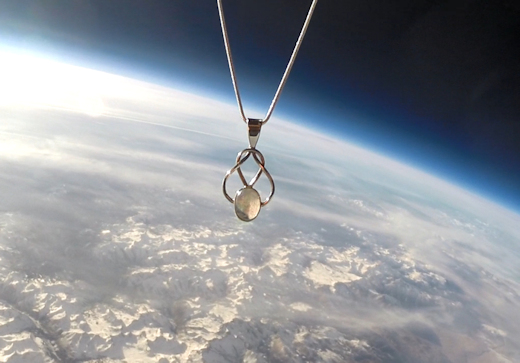
You can have it for $179.95. The students are selling these pendants to support their cosmic ray ballooning program. Each one comes with a greeting card showing the item in flight and telling the story of its journey to the edge of space. All sales support the Earth to Sky Calculus cosmic ray ballooning program and hands-on STEM research.
Far Out Gifts: Earth to Sky Store
All sales support hands-on STEM education
AURORAS IN THE SHAPE OF A PHOENIX: Solar wind is blowing around Earth faster than 600 km/s. Last night, the onrushing gas sparked auroras over Norway in the shape of a Phoenix:

"The aurora show over Senja, Norway, on Nov. 11th was nothing short of magical," reports photographer Adrien Mauduit. "During one outburst of lights, this image appeared. Huge colorful pillars took the shape of a fiery bird."
According to mythology, the Phoenix dies in an outburst of colorful flame, then rises again. Indeed, the bird could return to the Arctic Circle on Nov. 12th as the solar wind continues to blow. Stay tuned. Free: Aurora Alerts.
TREMORS IN EARTH'S MAGNETIC FIELD: Solar wind flowing from a hole in the sun's atmosphere has been buffeting Earth's magnetic field since Nov. 9th. Stuart Green detected the tremors from his private magnetic observatory in Preston, Lancashire, UK:

"The solar wind delivered a double blow, moving magnetometer needles around the globe," reports Green. "The first wave arrived on November 9th at approximately 18:00 UT and lasted for 4.5 hrs. The second wave arrived almost 24 hrs later. It was less geoeffective than the first, although no less spectacular according to the beautiful images of the aurora being submitted to Spaceweather.com."
The squiggles in Green's chart represent changes in his local magnetic field. "The sensor is buried in my garden about 0.5 meters below the surface in an East/West orientation," he explains. "This allows very sensitive (sub nanotesla) measurements of magnetic declination during geomagnetic storms. The plot shows the change in magnetic flux density in nanotesla occurring between readings every few minutes."