EXITING THE SOLAR WIND: Earth is exiting a stream of solar wind that ignited an explosion of almost-mythical auroras over the Arctic Circle on Nov. 10th and 11th. Another stream of solar wind is coming. Estimated time of arrival: Nov. 18th. Stay tuned. Free: Aurora Alerts
LARGE SOLAR PROMINENCES: The face of the sun is almost completely blank. Not so the edge. Two of the largest prominences in years are dancing around the solar limb, shown here in a Nov. 13th image from NASA's Solar Dynamics Observatory:

Prominences are clouds of glowing-hot plasma held above the sun's surface by strong magnetic fields. These two are in a state of constant motion, meaning they could be on the verge of collapse. Debris from collapsing prominences can hit the stellar surface below, triggering a Hyder flare--a type of solar flare that does not require sunspots. Amateur astronomers with safe solar telescopes are encouraged to monitor developments.
Realtime Space Weather Photo Gallery
A GIFT FROM THE EDGE OF SPACE: Don't just see the Northern Lights, wear them! To support their cosmic ray balloon program, the students of Earth to Sky Calculus have flown a payload of Northern Light Pendants to the edge of space. This one reached an altitude 109,908 feet above Earth's surface:

You can have it for $79.95. The students are selling these pendants to pay their helium bill. Each one comes with a greeting card showing the item in flight and telling the story of its journey to the edge of space. All sales support the Earth to Sky Calculus cosmic ray ballooning program and hands-on STEM research.
Far Out Gifts: Earth to Sky Store
All sales support hands-on STEM education
AMATEUR ASTRONOMERS FIND A BRIGHT NEW COMET: There's a new comet in the morning sky. Discovered just last week by three amateur astronomers--one in Arizona and two in Japan--Comet Machholz-Fujikawa-Iwamoto (C/2018 V1) has quadrupled in brightness over the past few days. "It is now glowing like a fuzzy 8th magnitude star in the constellation Virgo," reports Michael Jäger of Turmkogel, Austria, who photographed it on Nov. 11th:
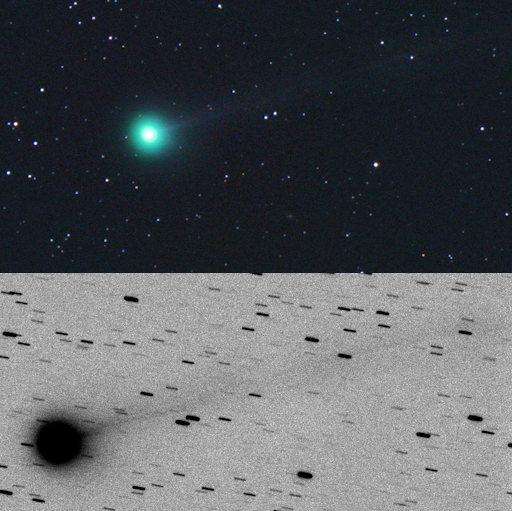
"The discovery of a comet by amateur astronomers is a rare event nowadays because robotic Near-Earth-Object search programs usually catch them first," he says. "My special congratulations to the three discoverers."
Comet Machholz-Fujikawa-Iwamoto appears to be a first-time visitor to the inner solar system. It is plunging toward the sun on nearly-parabolic orbit that will take it just inside the orbit of Mercury. Closest approach to the sun (0.38 AU) is on Dec. 3-4; closest approach to Earth (0.67 AU) is Nov. 27th.
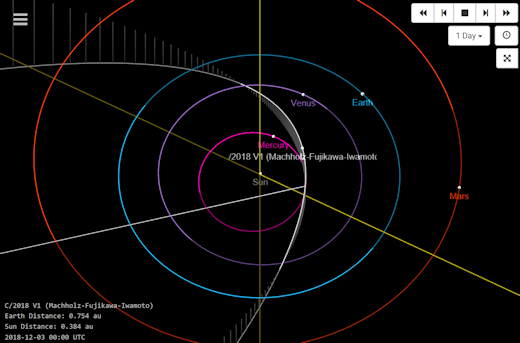
Click to view the comet's 3D orbit
Fresh comets like this one are notoriously unpredictable. They can surge in brightness, seeming to promise a spectacular display, when suddenly they fizzle as fragile deposits of ice are exhausted by solar heat. No one knows if Comet Machholz-Fujikawa-Iwamoto will even become a naked eye object. At the moment it is an easy target for backyard telescopes with the promise of ... unpredictability. Stay tuned!
Resources: 3D Orbit; Ephemeris; Orbital Elements; Sky Maps.