GEOMAGNETIC STORM PREDICTED: NOAA forecasters say there is a 70% chance of minor G1-class geomagnetic storms on Dec. 1st and 2nd when a stream of solar wind hits Earth's magnetic field. The gaseous material is flowing from a large hole in the sun's atmosphere. This is a long-lasting hole that has lashed Earth with solar wind about once a month since July. The last time it happened on Nov. 4th, auroras were sighted in US states including Wyoming, Montana, Iowa, Washington, North Dakota and, of course, Alaska. It could happen again this weekend. Free: Aurora Alerts.


ELECTRIC-BLUE CLOUDS OVER ANTARCTICA: NASA's AIM spacecraft is monitoring an outbreak of electric-blue clouds high above Antarctica. These are "noctilucent clouds" (NLCs). They form when wisps of summertime water vapor wrap themselves around meteor smoke, forming swarms of ice crystals at the edge of space. Here they are blanketing West Antarctica on Nov. 27th:

"This is the season for noctilucent clouds in the southern hemisphere," says Cora Randall, a member of the AIM science team at the University of Colorado's Laboratory for Atmospheric and Space Physics."They typically appear in November and persist until February. We began seeing clouds this year on Nov. 21st."
If you think strange clouds in the atmosphere over remote Antarctica are of little practical interest, think again. Researchers have discovered unexpected teleconnections between noctilucent clouds and weather patterns thousands of miles away. Would you believe that winter air temperatures in Indianapolis, Indiana, are correlated with NLCs over Antarctica? It's true. Understanding how these long-distance connections work could improve climate models and weather forecasting.

Although NLCs can be seen from the ground, sightings in the southern hemisphere are rare. The population density of Antarctica is just too low. Earlier this year, however, Jorgelina Alvarez of Argentina's Marabio Base on the Antarctic Peninsula took this rare picture:

"It was an incredible evening," says Alvarez. "We were amazed by the beauty of the noctilucent clouds on Feb. 9, 2018. Noctilucent clouds are formed at the edge of space in the atmospheric layer called the mesosphere. When a meteor hits the atmosphere it leaves behind a trail of dust at a distance ~80 km above the earth where the air is almost empty. Water vapor adheres to the dust left by the meteorite, creating these beautiful clouds."
A GIFT FROM THE EDGE OF SPACE: Are you looking for a far-out gift? Nothing says "Merry Christmas" like a gem from the edge of space. The students of Earth to Sky Calculus flew this moonstone wrapped in a hand-crafted sterling silver Celtic love knot 35.1 km (115,158 feet) above Earth's surface:
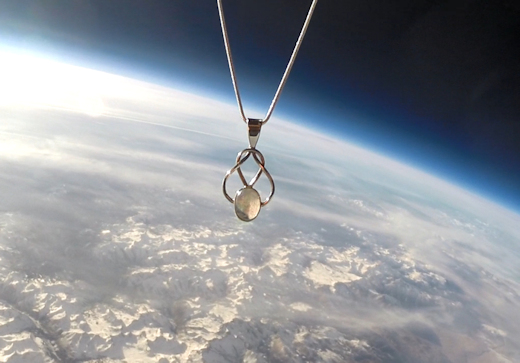
You can have it for $179.95. The students are selling these pendants to support their cosmic ray ballooning program. Each one comes with a greeting card showing the item in flight and telling the story of its journey to the edge of space. All sales support the Earth to Sky Calculus cosmic ray ballooning program and hands-on STEM research.
Far Out Gifts: Earth to Sky Store
All sales support hands-on STEM education
Realtime Space Weather Photo Gallery