CME IMPACT POSSIBLE THIS WEEK: NOAA forecasters say there is a 45% chance of G1-class geomagnetc storms on Dec. 5th when a coronal mass ejection (CME) is expected to hit Earth's magnetic field. CMEs are rare during solar minimum because their usual launching pads--that is, sunspots--are absent. This one was produced not by a sunspot, but rather by a filament of magnetism erupting from the sun's southern hemisphere (movie). CMEs are very good at producing auroras, so even a glancing blow could light up the Arctic Circle this Wednesday night. Free: Aurora Alerts.

A COMET AS BIG AS THE FULL MOON: On Dec. 16th, Comet 46P/Wirtanen will approach Earth less than 11.5 million km away–making it one of the 10 closest-approaching comets of the Space Age. It's a small comet, with a nucleus barely 1 km wide, but such proximity makes even a small things appear large. The comet's gaseous atmosphere is now as wide as a full Moon. Mike Broussard of Perry, Louisiana, photographed the comet on Dec. 2nd and inserted the Moon for scale:
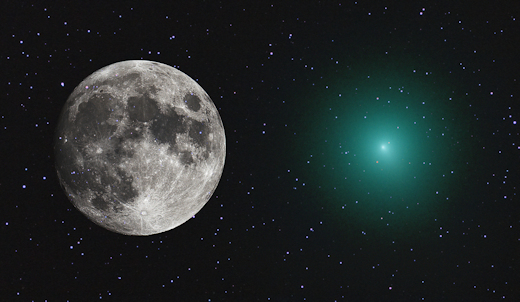
"The comet still has a couple of weeks before closest approach and it is already as big as a full Moon," says Broussard, who could see the comet with his naked eye--"just barely using averted vision and only when it was in the darkest section of the sky," he adds.
Despite its close approach, 46P/Wirtanen will never become a Great Comet like Comet Hayakutake in 1996 or Comet Hale-Bopp in 1997. Wirtanen's relatively small core of dirty ice cannot produce enough gas and dust to create a really bright, flamboyant tail. The best case scenario is probably a big diffuse cloud of magnitude +3 or +4, barely visible to the unaided eye but an easy target for binoculars and small wide-field telescopes.
Last night in Cape Cod, Massachusetts, photographer Chris Cook didn't even need a telescope to capture Wirtanen's green glow. He took this picture using a Canon 6D digital camera with a 35 mm lens:
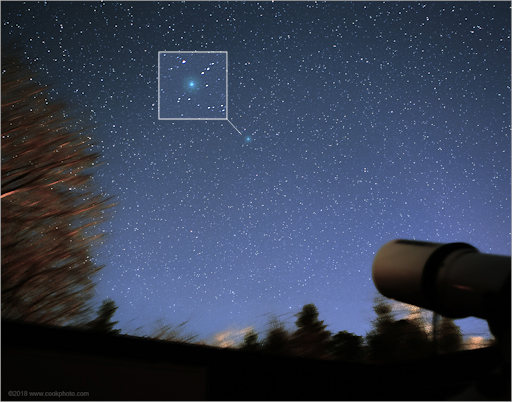
"This was my first sighting of Comet 46P/Wirtanen--just under naked eye visibility for my skies, but in 7x50 binoculars I could see a very large coma (ball of gas) almost 1° in diameter!" reports Cook. "It reminds me of Comet Hayakutake's massive coma but not nearly as bright."
Celebrated astrophotographer Juan Carlos Casado, who last night took his own HDR image of the comet above a church tower in Spain, offers some advice to novices: "Use Raw file format, a fast lens (at least f/2.8) and ISO settings between 1600 and 3200. The exposure will depend on the focal length. I normally use the 500 rule--that is, exposure = 500 / focal (mm) with a tripod. It also helps in areas with light pollution to use an antipollution filter. I am now using Optolong L-Pro clip filter which gives excellent color balance."
On the nights of closest approach, 46P/Wirtanen can be found in the constellation Taurus rising in the east at sunset and high in the sky at midnight. Sky watchers in the northern hemisphere may orient themselves using these sky maps: Dec. 5, Dec. 6, Dec. 7, Dec. 8, Dec. 9, Dec. 10, Dec. 11, Dec. 12, Dec. 13, Dec. 14, Dec. 15, Dec. 16


More resources: orbital elements; ephemeris; 3D orbit; light curve.
APOLLO 8 EDGE OF SPACE ORNAMENT: Fifty years ago this Christmas Eve, astronauts in the Apollo 8 command module snapped one of the most famous pictures of the Space Age: Earth rising above the cratered surface of the Moon. To celebrate, the students of Earth to Sky Calculus have flown an Apollo 8 Christmas ornament to the stratosphere:
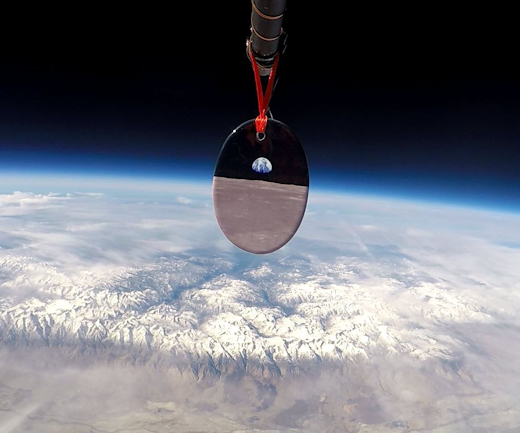
You can have one for $79.95. They make great gifts for space fans and are a far-out addition to any Christmas tree. Each ornament comes with a greeting card showing the ceramic disk in flight and telling the story of its journey to the edge of space.
This ornament traveled 109,354 feet above the Sierra Nevada mountains of central California, which had just received a blanket of snow from an early-season winter storm. During the flight it experienced temperatures as low as -65 C, air pressures only 0.2% of sea level, and cosmic ray dose rates 100x Earth-normal.
Far Out Gifts: Earth to Sky Store
All sales support hands-on STEM education
Realtime Space Weather Photo Gallery