CHINESE SPACECRAFT ORBITS THE MOON: China's Chang'e-4 spacecraft is now orbiting the Moon following a four and a half day journey from Earth. Chang'e-4 is on an unprecedented mission to land on the Moon's farside. First, though, mission scientists must adjust the spacecraft's orbit and test a communication link between Earth and the mission's relay satellite "Queqiao," according to the China National Space Administration. Stay tuned for updates.
METEORS FROM A ROCK COMET: The Geminid meteor shower is underway as Earth enters a stream of debris from rock comet 3200 Phaethon. Forecasters expect the shower to peak on Dec. 13th or 14th with as many as 100 meteors per hour. Exactly one year ago, during the peak of the 2017 Geminids, Wally Pacholka witnessed this fireball over the desert northeast of San Diego, CA:

"A brilliant Geminid fell over the Jeep Sculpture in Anza Borrego Springs," recalls Pacholka. "It was a beauty!"
More bright Geminids are in the offing. Perhaps because of its gravelly nature, the shower is rich in fireballs--that is, meteors brighter than the planet Venus. Indeed, last night NASA's network of all-sky meteor cameras captured 23 Geminid fireballs over the United States--numbers that will increase sharply in the nights ahead.
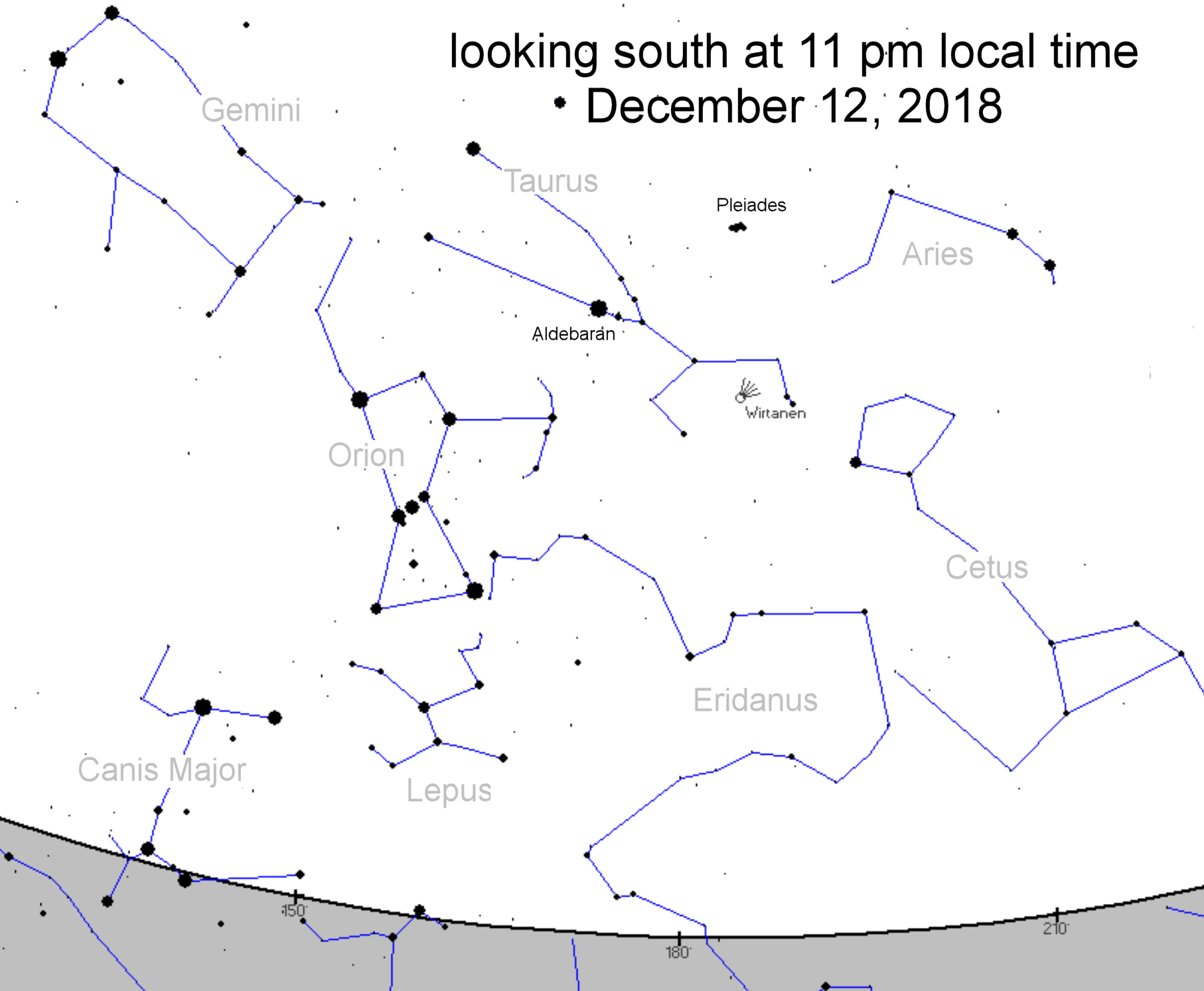
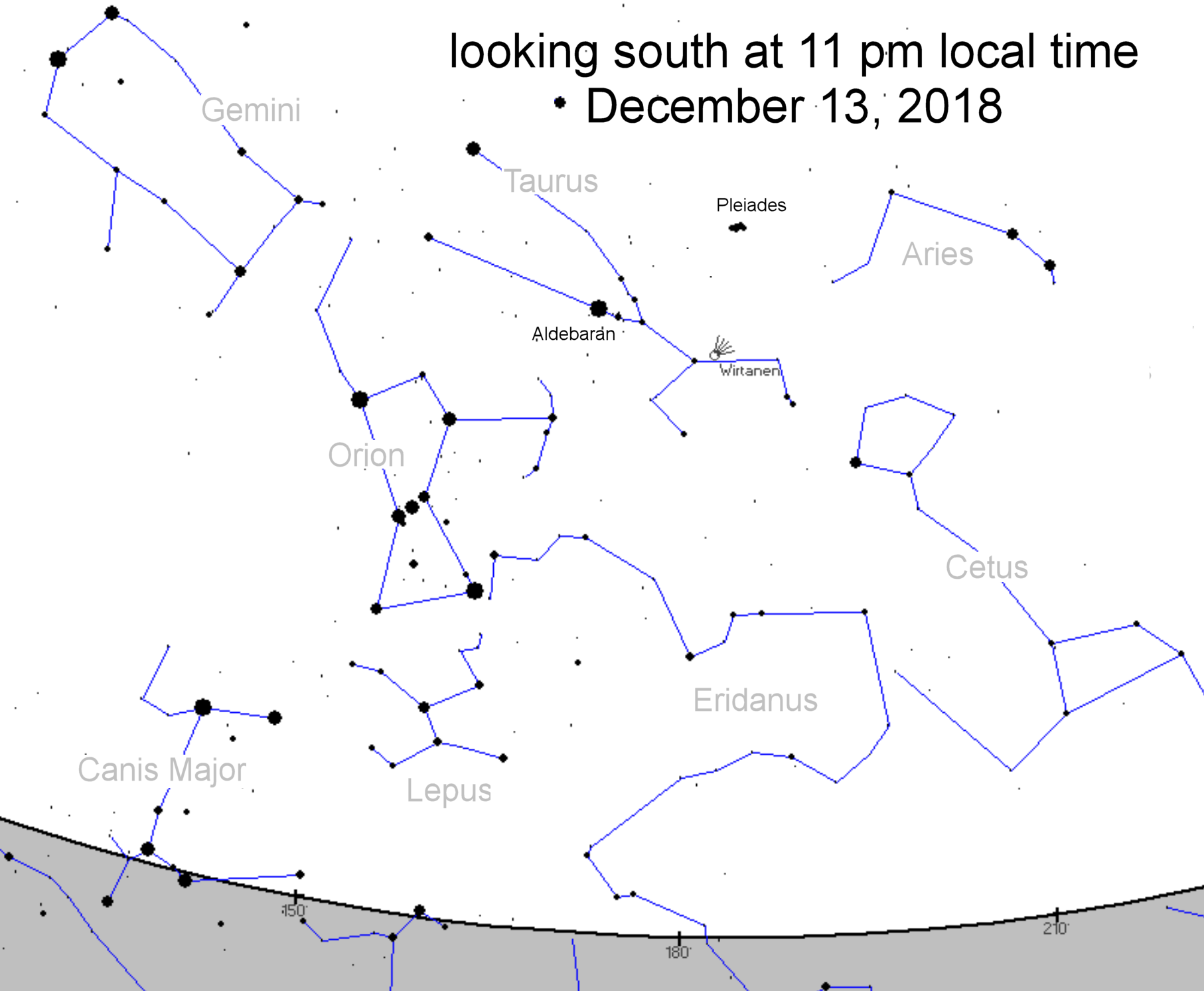
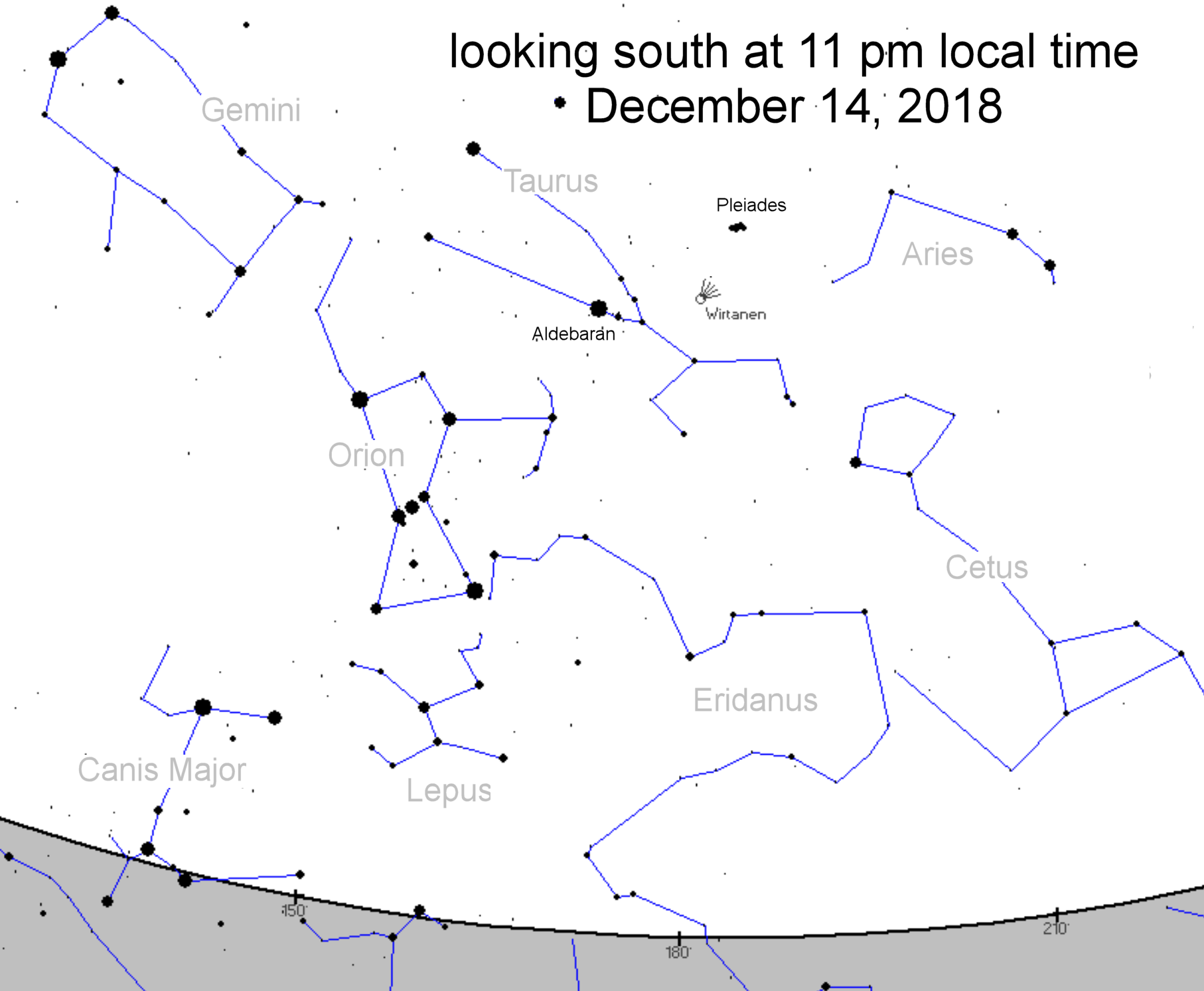
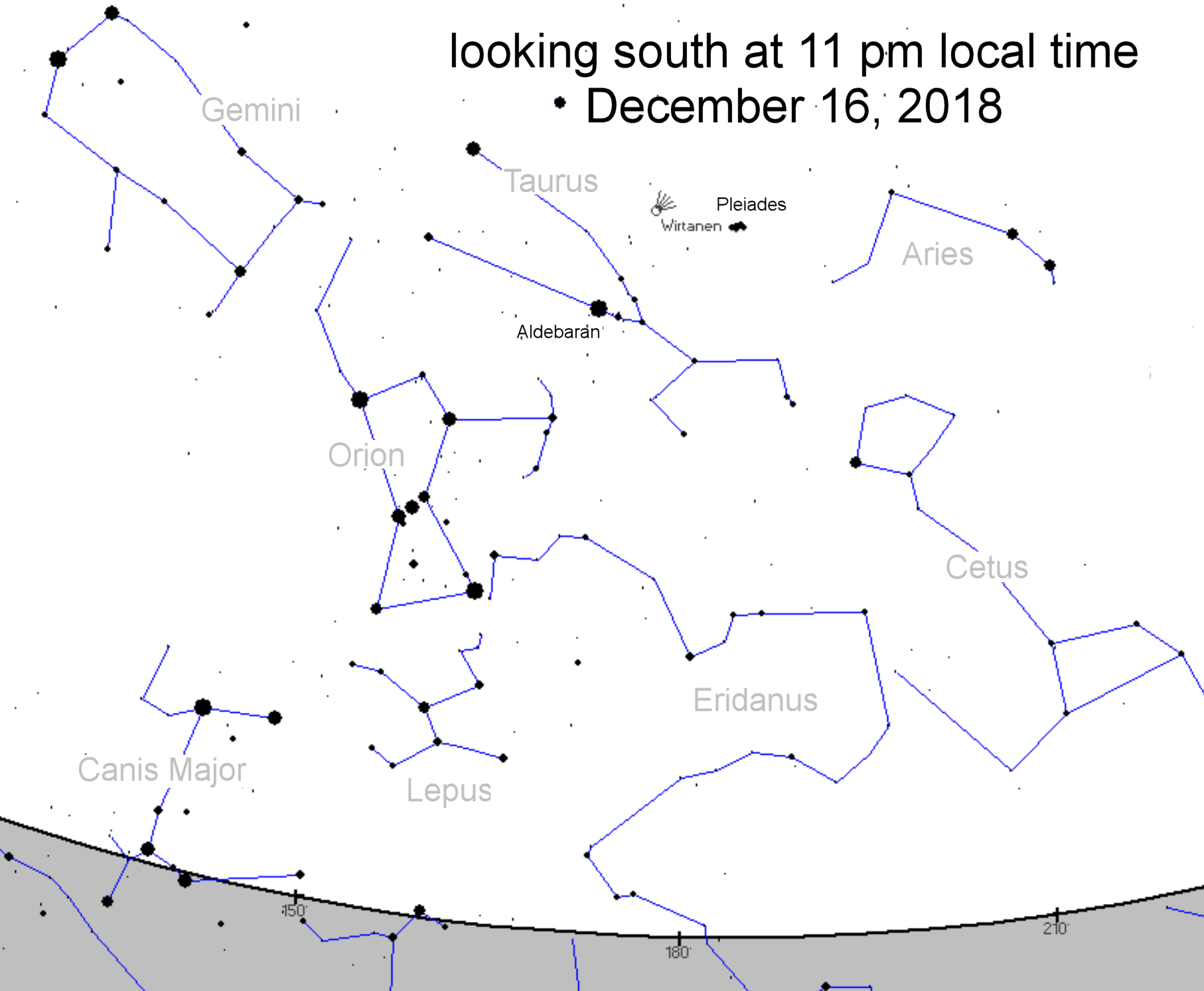
To see the greatest number of Geminids, the best time to look is during the dark hours before dawn when the constellation Gemini is high in the sky. On the other hand, if you would like to see a Geminid streak past Comet 46P/Wirtanen, a better time would be during hours before midnight when the comet "up" as well. These sky maps are tailored to that purpose: Dec. 12, Dec. 13. Dec. 14.


Realtime Space Weather Photo Gallery
CHRISTMAS GIFTS FROM THE EDGE OF SPACE: So far in 2018, the students of Earth to Sky Calculus have launched 42 space weather balloons to the stratosphere, measuring cosmic rays over 3 continents, 2 hemispheres, and 7 different US states. You can help them pay their helium bill by purchasing a Christmas gift from the edge of space:

Every item in the Earth to Sky Store has flown to the stratosphere alongside an array of cosmic ray sensors. Carried aloft by giant balloons, these unique gifts travel above 99.7% of Earth's atmosphere, experiencing space-like blasts of cosmic rays, extreme cold, and a wild ride parachuting back to Earth after the balloon explodes. Even Amazon doesn't carry items this far out!
Don't forget to enter coupon code "SPACESANTA" at checkout for a 10% holiday discount.
Far Out Gifts: Earth to Sky Store
All sales support hands-on STEM education
CHRISTMAS COMET WIRTANEN: Comet 46P/Wirtanen is approaching Earth for an historic encounter on Dec. 16th--one of the 10 closest comet flybys of the Space Age. Some people are calling it the "Christmas Comet." Indeed, it seems to be an excellent tree-topper:

"I took this picture from the forest outside Bleikvassli, Norway, on Dec. 12th" says photographer Tommy Eliassen. "The comet is in the constellation Taurus, which I positioned behind a tall tree for this Christmas composition."
Although the comet is coming very close to Earth, it is not extremely bright. Wirtanen's icy nucleus is small (~1 km) compared to greater comets such as Hale-Bopp (~30 km) and Halley (~15 km). At the moment it is glowing like a 4th or 5th magnitude star, barely visible to the unaided eye.
Now for the good news: This comet is a spectacularly easy target for digital cameras with exposures as short as 10 to 30 seconds. Astrophotographer Juan Carlos Casado offers some advice to novices: "Use Raw file format, a fast lens (at least f/2.8) and ISO settings between 1600 and 3200. The exposure will depend on the focal length. I normally use the 500 rule–that is, exposure = 500 / focal length (mm). It also helps in areas with light pollution to use an antipollution filter. I am now using Optolong L-Pro clip filter which gives excellent color balance."
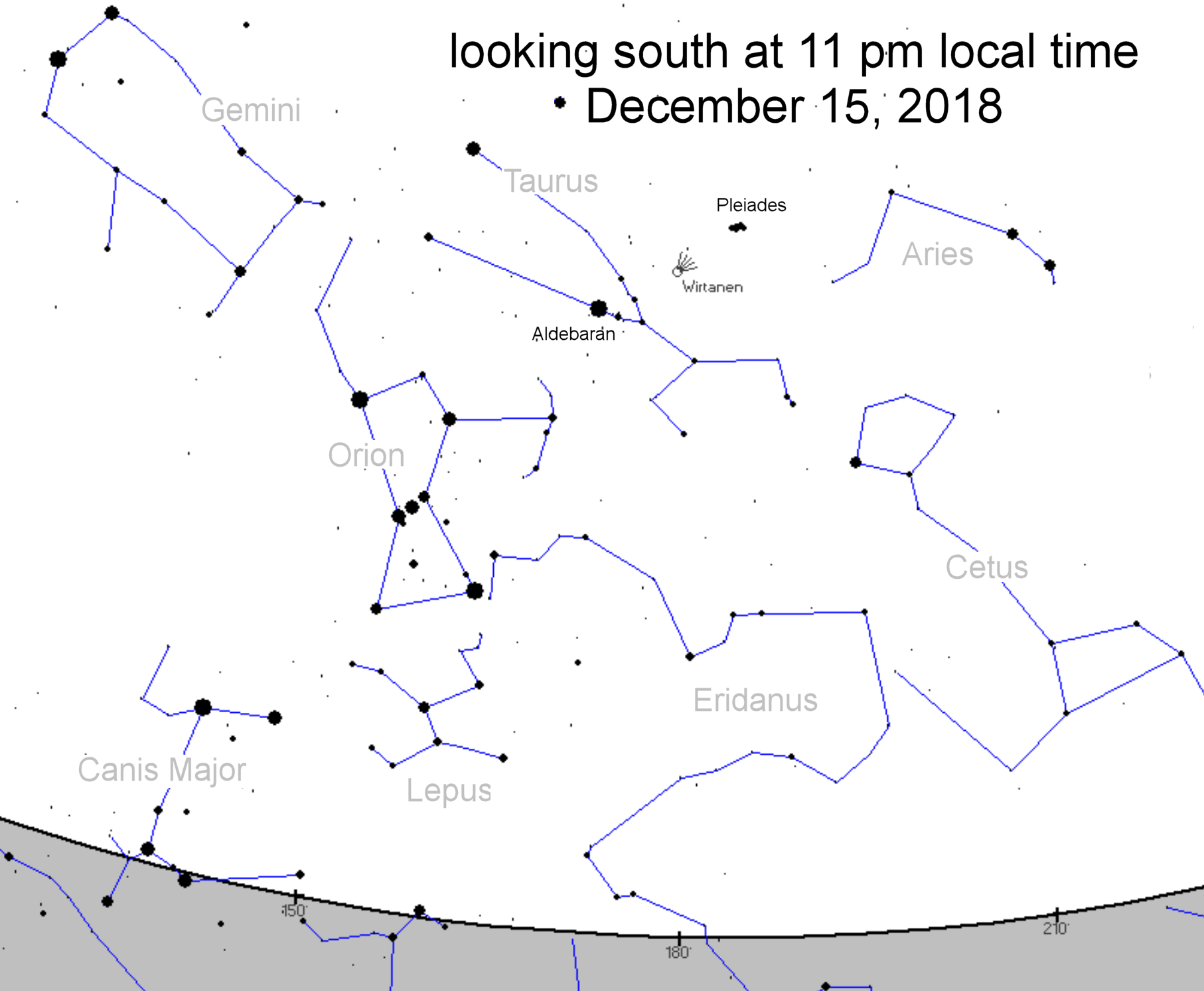
On the nights of closest approach, 46P/Wirtanen can be found in the constellation Taurus rising in the east after sunset. Sky watchers in the northern hemisphere may orient themselves using these sky maps: Dec. 12, Dec. 13, Dec. 14, Dec. 15, Dec. 16