ARCTIC AURORA WATCH: Earth's polar magnetic field could become unsettled later today when a minor stream of solar wind is expected to brush by our planet. The gaseous material is flowing from a shallow hole in the sun's atmosphere. Arctic sky watchers should be alert for auroras mixed with waxing moonlight. Free: Aurora Alerts.

CLOSE ENCOUNTER WITH A COMET: Today, Dec. 16th, Comet 46P/Wirtanen is making an historic close approach to Earth--only 11.5 million km away. This puts Wirtanen in the top 10 list of comet flybys during the Space Age. It's easy to find in the constellation Taurus, shown here in a photo taken just last night by Alan Dyer of Gleichen, Alberta:

"This is a tracked image with my camera mounted on a Star Adventurer tracker," says Dyer. "A sporadic meteor dashed through the field of view during the 2-minute exposure--a busy sky!"
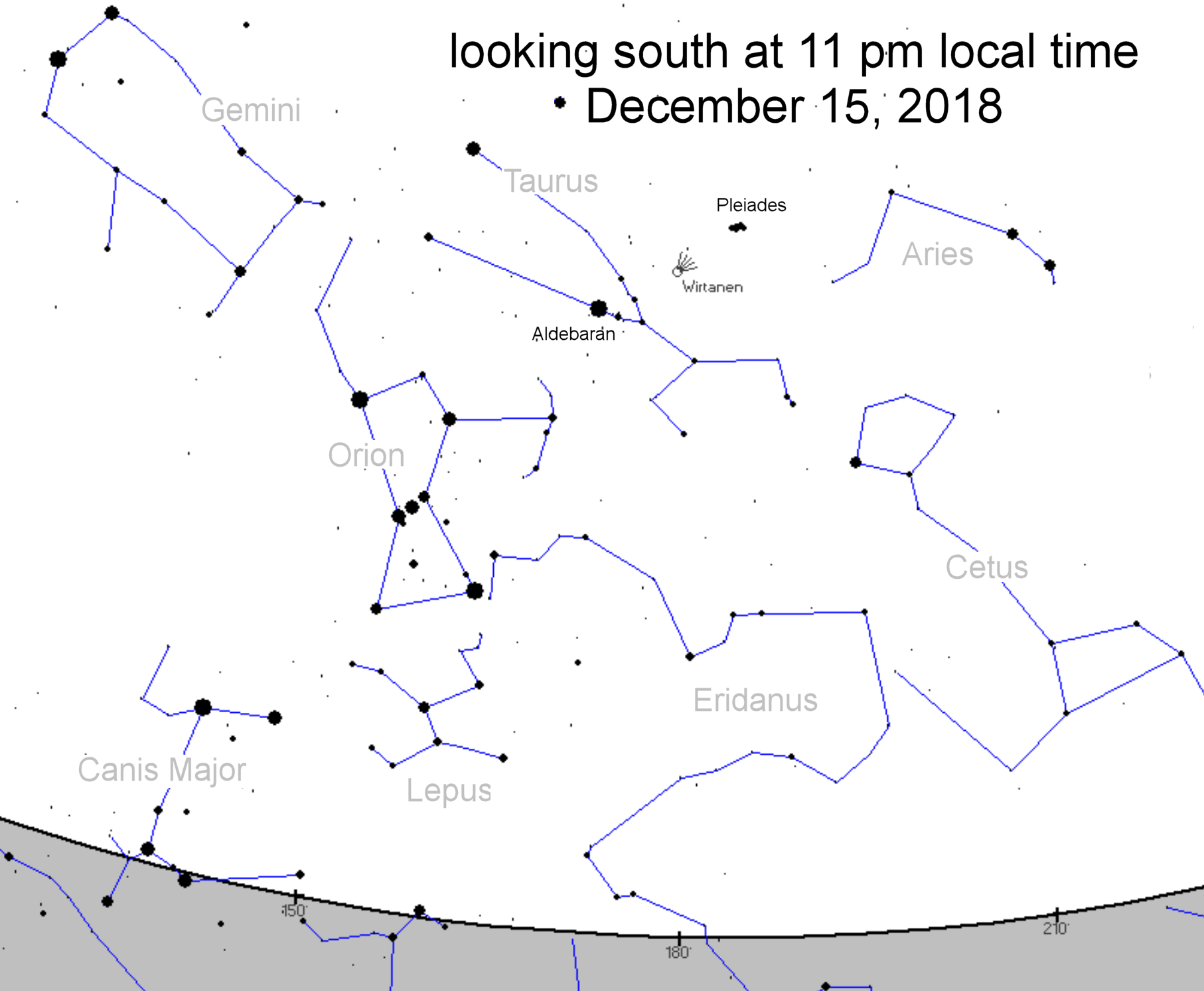
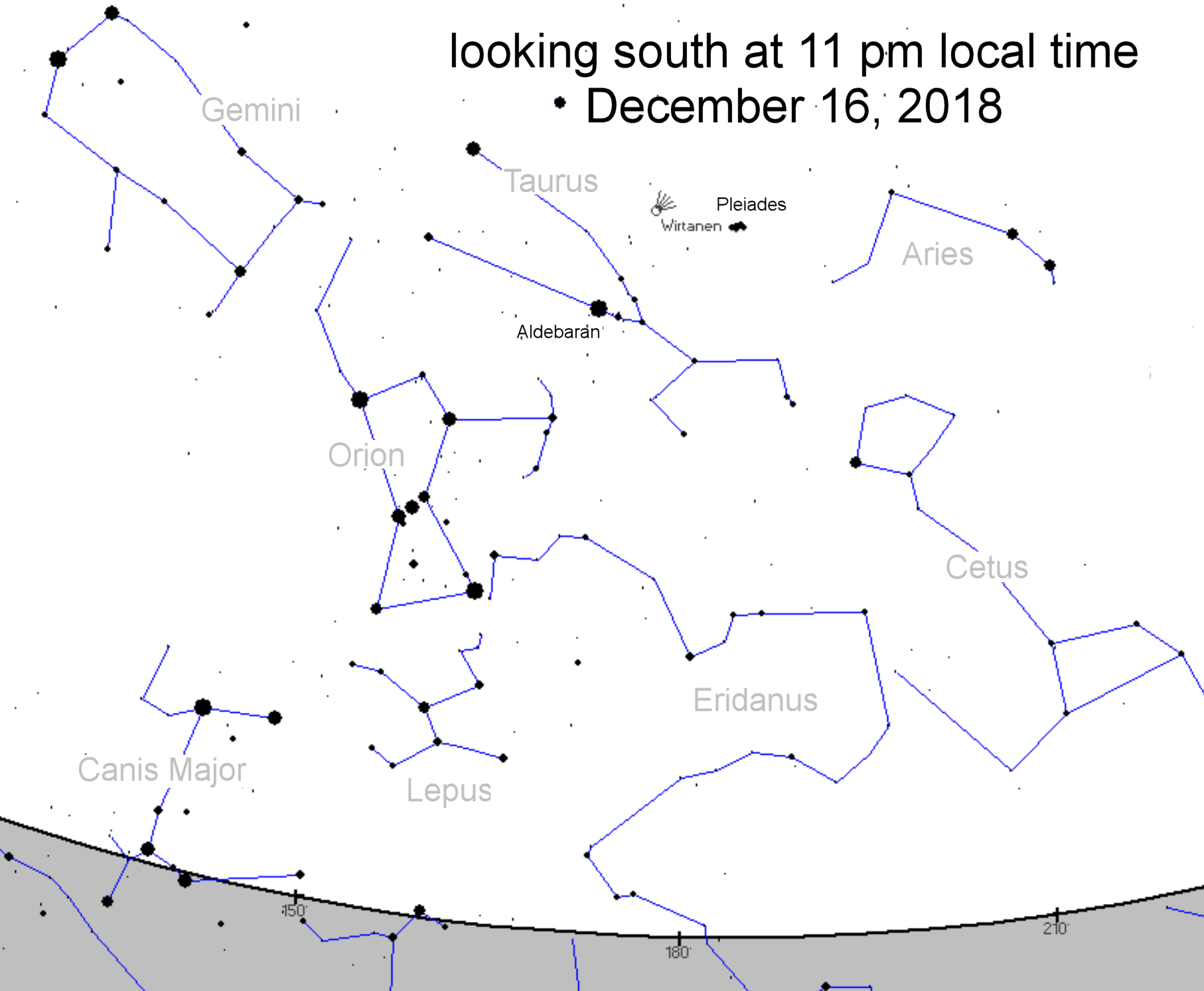
Dyer caught Comet 46P/Wirtanen splitting the gap between the Pleiades star cluster and Aldebaran, the red eye of the Bull. These are excellent landmarks that can guide you to the comet tonight. Indeed, you might need the help.
Although the comet is very close to Earth, it is not very bright. 46P/Wirtanen is a relatively small comet and, thus, barely visible to the unaided eye despite its proximity. Rural observers describe it as a faint misty cloud of 4th magnitude, about the size of a full Moon. It is nevertheless an easy target for digital cameras. Even a short exposure reveals the comet's spherical form and emerald green hue.
Still can't find it? Try using binoculars. Observers in urban areas say they are having good luck finding Wirtanen using hand-held optics. Simply scan the constellation Taurus for the green blob. Sky maps: Dec. 15, Dec. 16
ARIZONA SUN PILLAR: Icy clouds rolling over Tucson, Arizona, yesterday made Eliot Herman worry that he might not be able to see Comet 46P/Wirtanen. "This sun pillar was a nice consolation," he says.

As the sun set, a red column of light sprung into the cold desert air. The apparition was caused by ice. Plate-shaped crystals fluttering down from cirrus clouds caught the rays of the setting sun and smeared them into a vertical line--a "sun pillar."
"It made the end of the day special,"says Herman. "My backyard Saguaro cactus gave the pillar a sense of place."
Realtime Space Weather Photo Gallery
CHRISTMAS GIFTS FROM THE EDGE OF SPACE: So far in 2018, the students of Earth to Sky Calculus have launched 42 space weather balloons to the stratosphere, measuring cosmic rays over 3 continents, 2 hemispheres, and 7 different US states. You can help them pay their helium bill by purchasing a Christmas gift from the edge of space:

Every item in the Earth to Sky Store has flown to the stratosphere alongside an array of cosmic ray sensors. Carried aloft by giant balloons, these unique gifts travel above 99.7% of Earth's atmosphere, experiencing space-like blasts of cosmic rays, extreme cold, and a wild ride parachuting back to Earth after the balloon explodes. Even Amazon doesn't carry items this far out!
Don't forget to enter coupon code "SPACESANTA" at checkout for a 10% holiday discount.
Far Out Gifts: Earth to Sky Store
All sales support hands-on STEM education