SOLAR MINIMUM DEEPENS: The solar cycle is at low ebb. Today marks the 208th day in 2018 that the sun has been without spots, doubling the number of spotless days in 2017. The count won't be able to double again in 2019; there aren't enough days in the year! Nevertheless, we can expect a further deepening of Solar Minimum in the year ahead with, literally, hundreds of spotless days to come. Stay tuned for extra cosmic rays, long-lasting holes in the sun's atmosphere, and strangely pink auroras. Free: Aurora Alerts.
THE MYSTERY OF ULTIMA THULE: When NASA's New Horizons spacecraft flew past Pluto three years ago, mission scientists watching the first close-up images were shocked. Despite being stuck in the deep freeze of the Solar System 6 billion km from the sun, Pluto was not the frozen-stiff world many expected it to be. The geography of the dethroned 9th planet was alive with mountain ranges, windswept dunes, bladed terrain and much more. In one quick flyby, New Horizons turned planetary science on its head.
Get ready to be shocked again. New Horizons is less than 2 weeks away from a new world even more mysterious than Pluto.

Above: A speculative artist's concept of Ultima Thule with a small moon
Its name is "Ultima Thule" (2014 MU69), which means means "beyond the borders of the known world." Indeed, the little space rock is profoundly unknown. Located almost a billion kilometers farther from the sun than Pluto, Ultima Thule has never been much more than a faint speck of light in telescopes. It inhabits the distant Kuiper Belt where, seemingly, almost anything is possible.
"Really, we have no idea what to expect," says New Horizons principal investigator Alan Stern, of the Southwest Research Institute. "Will it have an atmosphere? Will it have rings? Will it have moons? Any of that could be possible, and soon we'll know the answers."
On New Year's Eve and New Year's Day, New Horizons will swoop three times closer to Ultima Thule than it flew past Pluto in July 2015, shattering previous records for the most distant body explored by a human spacecraft. First images will be posted on a web site set up by the New Horizons' team: SeeUltimaThuleNow.com

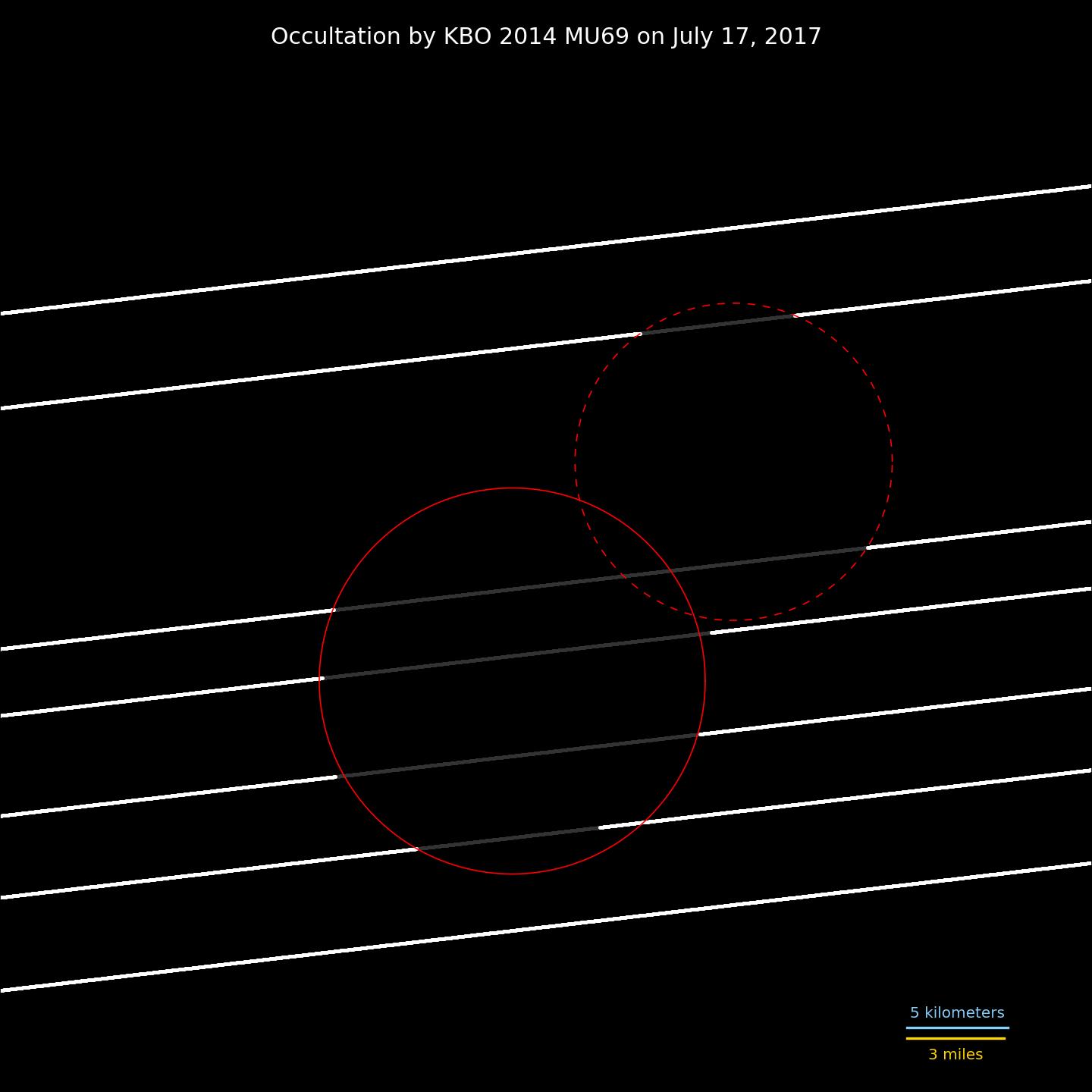
We already know one thing about Ultima Thule. Its shape is elongated and strange. In 2017, astronomers watched a distant star pass behind Ultima Thule. Starlight winked in and out in a pattern suggesting two lobes with diameters of 20 and 18 km, respectively. Ultima Thule could be a small binary system.
"Ultima Thule is 100 times smaller than Pluto, but its scientific value is incalculable," says Stern. "From everything we know, it was formed 4.5 or 4.6 billion years ago, 4 billion miles from the sun. It has been stored at that enormous distance from the sun, at a temperature of nearly absolute zero, ever since, so it likely represents the best sample of the ancient solar nebula ever studied."
"Nothing like it has ever been explored," he says.
Note: A sharable permalink this story may be found here.
Realtime Space Weather Photo Gallery
CHRISTMAS GIFTS FROM THE EDGE OF SPACE: So far in 2018, the students of Earth to Sky Calculus have launched 42 space weather balloons to the stratosphere, measuring cosmic rays over 3 continents, 2 hemispheres, and 7 different US states. You can help them pay their helium bill by purchasing a Christmas gift from the edge of space:

Every item in the Earth to Sky Store has flown to the stratosphere alongside an array of cosmic ray sensors. Carried aloft by giant balloons, these unique gifts travel above 99.7% of Earth's atmosphere, experiencing space-like blasts of cosmic rays, extreme cold, and a wild ride parachuting back to Earth after the balloon explodes. Even Amazon doesn't carry items this far out!
Don't forget to enter coupon code "SPACESANTA" at checkout for a 10% holiday discount.
Far Out Gifts: Earth to Sky Store
All sales support hands-on STEM education
GREEN COMET & GREEN AURORAS: A minor stream of solar wind is buffeting Earth's magnetic field, causing Arctic skies to fill with green auroras. Last night, Fredrik Broms of Kvaløya, Norway, photographed the display and found an extra condensation of green among the verdant waves of geomagnetic activity. It was Comet 46P/Wirtanen:

"Despite a spectacular aurora outburst, Comet 46P/Wirtanen could still be seen through the green veils as a denser green fuzzball," says Broms. "I've never thought of auroras as light-pollution before, but what a luxurious problem. The comet was still just about possible to see with the naked eye from my location after the Moon had set - at least when the auroras kept away. What a night!"
The comet might find itself surrounded by green again tonight. The solar wind continues to blow, stirring unrest in the polar magnetic field. Arctic photographers can find 46P/Wirtanen exiting the constellation Taurus en route to Capella. Sky maps: Dec. 18, 19, 20, 21.


