SOLAR MINIMUM CONDITIONS ARE IN EFFECT: The sun has been without sunspots for 212 days in 2018--that is, 60% of the time. To find a similar stretch of blank suns, you have to go back to 2009 when the sun was experiencing the deepest solar minimum in a century. Solar minimum has returned, bringing extra cosmic rays, long-lasting holes in the sun's atmosphere, and strangely pink auroras. Free: Aurora Alerts.
ULTIMA THULE'S FIRST PUZZLE: NASA's New Horizons spacecraft is 12 million km from Ultima Thule and closing fast. On New Year's Day, it will fly by the mysterious Kuiper Belt Object three times closer than it buzzed Pluto in 2015 revealing ... no one knows what. In fact, the mysteries have already begun.
Long range images of Ultima Thule reveal that it has no light curve. In other words, its brightness is constant.

Above: An artist's concept of Ultima Thule, a double-lobed object in the Kuiper Belt
"It's really a puzzle," says New Horizons Principal Investigator Alan Stern of the Southwest Research Institute. And here's why:
Last year, astronomers watched a distant star pass behind Ultima Thule. Starlight winked in and out in a pattern suggesting an elongated object with two bulbous lobes. Ultima Thule could be a binary system. You would expect the reflected brightness of such an object to vary as it rotates in the sunlight. Yet Ultima Thule does not behave that way.
What's going on? New Horizons science team members have different ideas. "It's possible that Ultima's rotation pole is aimed almost right at the spacecraft," speculates Marc Buie of the Southwest Research Institute. Such an alignment, however, is unlikely.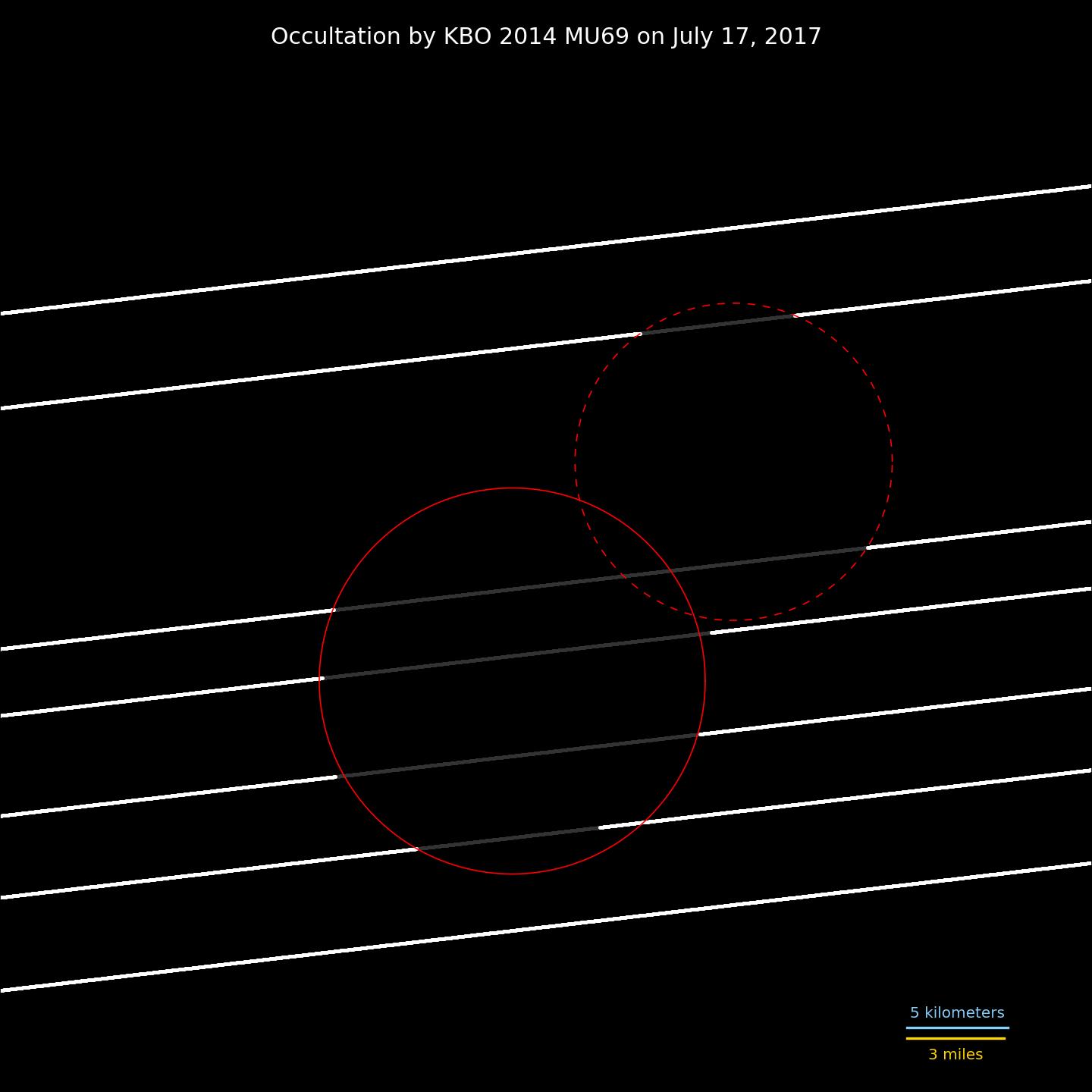
"Another explanation," says the SETI Institute's Mark Showalter, "is that Ultima may be surrounded by a cloud of dust that obscures its light curve--much the same way that a comet's coma often overwhelms the light reflected by its central nucleus."
"A more bizarre scenario is one in which Ultima is surrounded by many tiny tumbling moons," suggests University of Virginia's Anne Verbiscer, a New Horizons assistant project scientist. "If each moon has its own light curve, then together they could create a jumbled superposition of light curves that make it look to New Horizons like Ultima has a small light curve."
"It's hard to say which of these ideas is right," Stern says. "We'll get to the bottom of this puzzle soon – New Horizons will swoop over Ultima and take high-resolution images on Dec. 31 and Jan. 1, and the first of those images will be available on Earth just a day later. When we see those high--resolution images, we'll know the answer to Ultima's vexing first puzzle. Stay tuned!"
Realtime Space Weather Photo Gallery
BUY A TICKET TO THE EDGE OF SPACE: Need a last-minute Christmas gift? Consider this: For the holiday season only, we're reducing the cost of payload space on Earth to Sky Calculus balloons from $500 to only $299. Buy an edge of space gift certificate before Dec. 25th and you can send an experiment, photo, or keepsake item to the stratosphere, completely supported by an Earth to Sky Calculus launch and recovery team.

This is not only a great Christmas gift, but also a good kickstarter for science fair projects. Experiments will be flown and returned along with video footage, GPS tracking, temperature, pressure, altimetry and radiation data.
To take advantage of the discounted rate, payment must be received before Dec. 25th. However, the flight can take place at any time in the next 12 months. You'll receive the ticket electronically so you can print it out and give it as a Christmas Day gift.
Far Out Gifts: Earth to Sky Store
All sales support hands-on STEM education