THE NEXT GEOMAGNETIC STORM: A northern hole in the sun's atmosphere is turning to face Earth and it is spewing a stream of solar wind in our direction. Estimated time of arrival: Dec. 27th or 28th. Arctic sky watchers should be alert for auroras in the nights after Christmas. Free: Aurora Alerts.

IN ANTARCTICA, CHRISTMAS LIGHTS ARE ELECTRIC BLUE: NASA's AIM spacecraft is monitoring a 3000-mile wide ring of electric-blue clouds circling high above Antarctica. These are noctilucent clouds (NLCs), made of frosted "meteor smoke" glowing in the mesosphere 83 km above the frozen continent. A four week time-lapse video shows their development since late November:

This is the season for southern noctilucent clouds. Every year around this time, summertime water vapor billows up into the high atmosphere over Antarctica, providing moisture needed to form icy clouds at the edge of space. Tiny meteoroids seed the clouds, which glow electric-blue as sunlight shines through them.
"The current season began on Nov. 21st," says Cora Randall, a member of the AIM science team at the University of Colorado's Laboratory for Atmospheric and Space Physics. "At first, the clouds covered only a small fraction of Antarctica, but now almost all of the continent is blanketed by NLCs."
If you think strange clouds in the atmosphere over remote Antarctica are of little practical interest, think again. Researchers have discovered unexpected teleconnections between noctilucent clouds and weather patterns thousands of miles away. Would you believe that winter air temperatures in Indianapolis, Indiana, are correlated with NLCs over Antarctica? It's true. Understanding how these long-distance connections work could improve climate models and weather forecasting.

Realtime Noctilucent Cloud Photo Gallery
MINERAL MOON: What color is the Moon? If you had to pick a single hue, it would probably be gray--the color of lunar rock and moondust. Yet the Moon is not monochromatic. Last night, Maximilian Teodorescu of Magurele, Romania, photographed the almost-full Moon, and he found much more than gray:
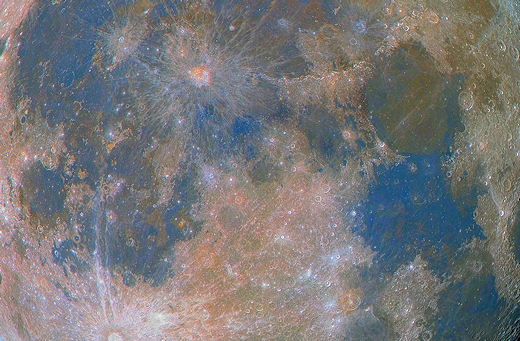
No filter was required to produce this image. The colors are naturally present and only need a bit of boosting with Photoshop to see. "I took great care to process the photo," says Teodorescu. "I believe it is my best and most correct 'mineral Moon' to date."
What do the colors mean? Blue denotes areas rich in titanium, while orange is titanium poor. The titanium-rich zones are particularly interesting because lunar titanium is bound to oxygen. The common lunar mineral ilmenite, for instance, is rich in titanium oxides. This oxygen may be easily extracted, providing future explorers a source of air to breath and oxidizer for rocket engines.
Scratching the lunar surface reveals a great deal more than gray, indeed.
Realtime Space Weather Photo Gallery
BUY A TICKET TO THE EDGE OF SPACE: Need a last-minute Christmas gift? Consider this: For the holiday season only, we're reducing the cost of payload space on Earth to Sky Calculus balloons from $500 to only $299. Buy an edge of space gift certificate before Dec. 25th and you can send an experiment, photo, or keepsake item to the stratosphere, completely supported by an Earth to Sky Calculus launch and recovery team.

This is not only a great Christmas gift, but also a good kickstarter for science fair projects. Experiments will be flown and returned along with video footage, GPS tracking, temperature, pressure, altimetry and radiation data.
To take advantage of the discounted rate, payment must be received before Dec. 25th. However, the flight can take place at any time in the next 12 months. You'll receive the ticket electronically so you can print it out and give it as a Christmas Day gift.
Far Out Gifts: Earth to Sky Store
All sales support hands-on STEM education