TWO DAYS FROM ULTIMA THULE: NASA's New Horizons spacecraft is closing in on Ultima Thule, a mysterious object 4 billion miles from Earth. On New Year's Eve and New Year's Day, New Horizons will swoop three times closer to Ultima Thule than it flew past Pluto in 2015. "The anticipation is palpable now: we are on the verge of an important scientific exploration almost 20 years in the making and, in many ways, unlike any other ever attempted," says the mission's principal investigator Alan Stern. Stay tuned for live coverage despite the US government shutdown.
RARE VIDEO OF CLOUDS IN THE STRATOSPHERE: The habits of a weatherman are hard to break--even on holiday. So it was that Dutch meteorologist Jacob Kuiper found himself outside on Christmas morning, looking up. What he saw amazed him. "The sky was filling with strange clouds," says Kuiper. "At first I thought they were some form of cirrus, but these clouds were uncommonly wavy with unusual curls. When I saw the telltale flashes of color, I realized they must be polar stratospheric clouds (PSCs)."
Kuiper made a time-lapse video of the display. Note the hypnotic waves and how, at the 25 second mark, ordinary clouds may be seen scudding far below them:
Polar stratospheric clouds are not your ordinary Christmas clouds. Indeed, they have little to do with regular weather, floating so high above Earth that even airplanes cannot reach them.
Normally, the stratosphere is free of clouds--completely transparent. It's very dry up there with a wide separation between molecules of water. When the temperature drops to around -85ºC, however, those sparse molecules begin to reluctantly gather, forming crystals of ice that become PSCs.
"I have been working in the National Meteorological Office in the central part of The Netherlands (KNMI) for 40 years," says Kuiper. "Only twice have I seen a display of stratospheric clouds this widespread. It was thrilling. I didn't expect the stratosphere over our country to be cold enough, but one of the stratosphere scientists in our Met. Office confirmed my idea. He also was quite surprised."
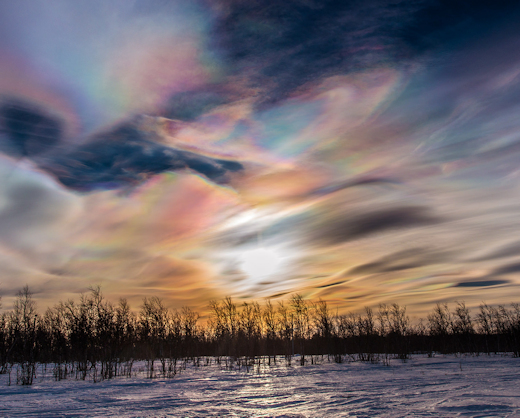
Above: PSCs inside the Arctic Circle in 2017. Photo credit: Mia Stålnacke of Kiruna, Sweden
Tiny ice crystals in PSCs can produce episodes of iridescence so brilliant that they are sometimes mistaken for auroras. The display Kuiper recorded contained only a few brief flashes of those colors--just enough for an identification.
PSCs come in two varieties: Type I contains hydrated droplets of nitric acid and sulphuric acid. These are chemicals that can destroy ozone. Indeed, an ozone hole formed over the UK in Feb. 2016 following an outbreak of Type 1 PSCs. Type II PSCs are icy and colorful, and they do little damage to the ozone layer. The clouds Kuiper witnessed may be a mixture of both.
The display was so rare that researchers in the Met Office conducted an extra round of Christmas radio soundings to probe the stratosphere. They are still processing the data, so stay tuned!
Realtime Space Weather Photo Gallery
BUY A TICKET TO THE EDGE OF SPACE: Extended by popular demand! For the holiday season only, we're reducing the cost of payload space on Earth to Sky Calculus balloons from $500 to only $299. Buy an edge of space gift certificate before New Year's Eve and you can send an experiment, photo, or keepsake item to the stratosphere, completely supported by an Earth to Sky Calculus launch and recovery team.

This is not only a great belated Christmas gift, but also a good kickstarter for science fair projects. Experiments will be flown and returned along with video footage, GPS tracking, temperature, pressure, altimetry and radiation data.
To take advantage of the discounted rate, payment must be received before Dec. 25th. However, the flight can take place at any time in the next 12 months. You'll receive the ticket electronically so you can print it out and give it as a Christmas Day gift.
Far Out Gifts: Earth to Sky Store
All sales support hands-on STEM education