SOLAR WIND, INCOMING: On Jan. 4th and 5th, high-speed solar wind flowing from a large hole in the sun's atmosphere will hit Earth's magnetic field. Minor geomagnetic storms and Arctic auroras are likely when the gaseous material arrives. Aurora visibility will be boosted by the dark skies of a New Moon. Free: Aurora Alerts

FIRST IMAGES OF ULTIMA THULE: The first high-resolution images of Ultima Thule have reached Earth following New Horizons' historic flyby on New Year's Day. Hot off the presses, the photos reveal a pair of roughly spherical planetestimals stuck together in the middle. The contact binary strangely resembles BB-8:
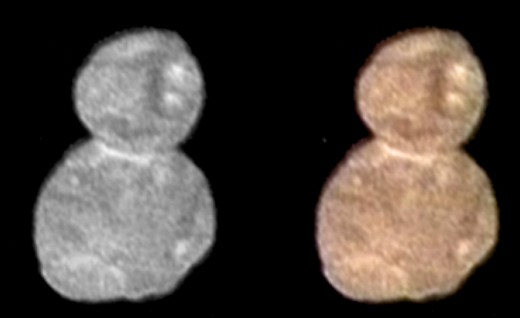
"This flyby is a historic achievement," says New Horizons Principal Investigator Alan Stern of the Southwest Research Institute in Boulder, Colorado. "Never before has any spacecraft team tracked down such a small body so far away in the abyss of space. We're getting our first close-up look at ancient planetesimals."
Planetestimals are the building blocks of planets. Here in the inner solar system, no pristine examples remain for us to study. They have been swallowed by planets, hammered by asteroids, and scorched by solar radiation. Ultima Thule, however, has been preserved in the deep freeze of the outer solar system for more than 4 billion years. It is truly a relic of the genesis of planets.
Mission scientists believe that Ultima Thule formed by accretion. A swarm of smaller planetesimals gathered under the pull of their own meagre gravity to form two spherical bodies, medium-sized planetesimals which themselves slowly bumped together and stuck. The result was Ultima Thule.

This is just the beginning of Ultima Thule's revelations. First images released today have a resolution of about 140 meters per pixel. Images arriving in the days and weeks ahead will be as much as 5 times sharper, possibly revealing craters, hills, landslides, rilles and other unknowns.
New Horizons also scanned the area for tiny moons--the debris of the original swarm that gave birth to this strange object. Detections, if any, will be revealed in future transmissions from the spacecraft. Stay tuned!
Browse: Slides from today's science briefing and the latest images from New Horizons
Realtime Space Weather Photo Gallery
GIFTS FROM THE EDGE OF SPACE: The students of Earth to Sky Calculus are about to kick off a new year of cosmic ray balloon launches, continuing a 5-year campaign to monitor increasing levels of radiation in Earth's atmosphere. You can help. Buy any gift item from the Earth to Sky Store and we'll give you 10% off to celebrate the New Year.

All items in the Earth to Sky Store have flown to the edge of space onboard cosmic ray balloons. Each one comes with a greeting card showing the item in flight and telling the story of its journey. All sales support the Earth to Sky Calculus cosmic ray ballooning program and hands-on STEM research.
Far Out Gifts: Earth to Sky Store
All sales support hands-on STEM education
THE FIRST AURORAS OF 2019: The first auroras of 2019 have been sighted in Finland. "Happy New Year to the readers of Spaceweather.com!" says Rayann Elzein who sends this picture from Inari in the Finnish Lapland:

"The lights appeared at half past midnight on Jan. 1-2," says Elzein, "They coincided almost perfectly with an episode of negative Bz." In other words, a crack opened in Earth's magnetic field. A weak stream of solar wind poured through the gap, fueling the display.
An even better display is in the offing. On Jan. 4th and 5th, high-speed solar wind flowing from a large hole in the sun's atmosphere will hit Earth's magnetic field. Bright Arctic auroras are a near certainty, boosted in visibility by the dark skies of a New Moon. 2019 is off to a good start. Free: Aurora Alerts