CHINA FARMS THE MOON: There a new form of life on the Moon. It's a potato. Photos released today by the China National Space Administration show that rapeseed, potato and cotton seeds are sprouting inside the Chang'e-4 lunar lander, which touched down on the Moon's farside earlier this month. This experiment in far-out farming could pave the way for future Chinese astronauts to live and work on the Moon. NASA, meanwhile, is on furlough. Free: SWx Newsletter
A COLLISION IN THE ASTEROID BELT: Last week, astronomers working with the ATLAS project in Hawaii announced an astonishing change to asteroid 6478 Gault. The space rock had sprouted a tail. It is now gliding through the asteroid belt giving every appearance of being a comet. On Jan. 9th, Damian Peach of Selsey UK photographed the 6478 Gault and its 400,000 kilometer-long tail:

"This is a 60 minute sequence of images, which I captured using a 20-inch telescope," says Peach.
What happened to 6478 Gault? A clue may be found in its lineage. Asteroid Gault is a member of the Phocaea family, a swarm of rocks in the inner asteroid belt that formed as a result of inter-asteroid collisions some 2.2 billion years ago. The family gets its name from its most massive survivor, 25 Phocaea, which is about 75 km in diameter.
Gault's tail may be a result of a recent collision. Researchers with the ATLAS project have looked at images of Gault in Dec. 2018 and Jan. 2019. Extrapolating its appearance backwards in time, they suggest that Gault hit another object in the asteroid belt in Nov. 2018. If that idea is correct, the tail would be debris from the crash.
Asteroid Gault was discovered in 1988 by the famous astronomer couple Carolyn and Eugene Shoemaker at the Palomar Observatory in California. For the next 30 years, the 4-km wide space rock did little to attract attention. Now, astronomers around the world are eagerly monitoring 6478 Gault to see what happens next. Stay tuned.
Readers, would you like to take pictures like Damian Peach? He's willing to teach you how. Subscribe to his Patreon page for expert tutorials.
Realtime Space Weather Photo Gallery
FULL MOON VALENTINE'S PENDANT: Poets, lovers, and artists have long known this simple truth: Nothing is more romantic than a full Moon. Now you can give the full Moon as a Valentine's Gift--the full Moon space pendant, that is. This one flew to the stratosphere on Dec. 26, 2018, onboard an Earth to Sky Calculus cosmic ray balloon:
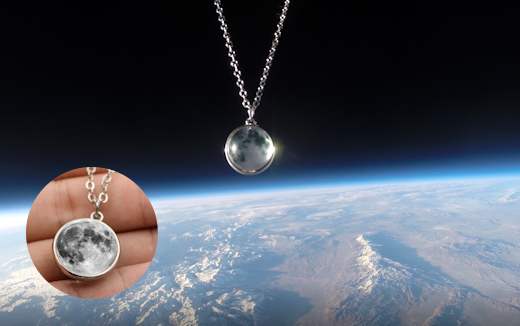
You can have it for $99.95. The students are selling these spherical glass pendants to support their cosmic ray ballooning program. Each one comes with a Valentine's card showing the pendant in flight and telling the story of its journey to the edge of space and back again.
Far Out Gifts: Earth to Sky Store
All sales support hands-on STEM education
THE COLOR OF SOLAR MINIMUM: The sun has been blank for 8 straight days--a sign that Solar Minimum is in progress. Another sign of Solar Minimum: strangely pink auroras. "The Spaceweather.com team has warned us to be alert for pink auroras during Solar Minimum, and here they are," reports Markus Varik, who took this picture last night in Tromsø, Norway:

"During our nights out shooting auroras, we have been getting more pinks than usual," says Varik, an experienced tour guide. "The pink colors often appear in linear bands similar to STEVE."
Does the palette of auroras really change during Solar Minimum? The evidence is anecdotal, but the idea is not far-fetched. During Solar Minimum, unusually long-lasting holes open in the sun's atmosphere, spewing streams of solar wind that lash Earth repeatedly month after month. Perhaps the chemical mix, magnetic structure, and repetition of these streams produces colors less often seen in other phases of the solar cycle. Aurora alerts: SMS Text