THE SOLAR WIND IS COMING: A hole in the sun's atmosphere is turning to face Earth, and it is spewing a stream of solar wind in our direction. Minor G1-class geomagnetic storms and polar auroras are possible when the gaseous material arrives on Jan. 23rd. Aurora Alerts: SMS text, email.


TOTAL ECLIPSE OF THE SUPERMOON: There's a total eclipse this weekend--and it's going to be super. On Sunday evening, Jan. 20th, at 8:41 pm PST (11:41 pm EST) the shadow of our planet will engulf the full Moon, transforming the grey lunar disk into a coppery-red orb. Totality lasts for more than an hour. This graphic created by science artist Larry Koehn depicts key moments of the eclipse in the Pacific time zone:

Other time zones are also available: GMT, AST, EST, CST, MST, PST, AKST, HST.


The eclipse will be "super" both figuratively and literally. During the shadow crossing, the Moon will be within 14 hours of perigee, its closest point to Earth. This makes the Moon a "supermoon," almost 8% wider than an average full Moon. Normally, a supermoon would be about 16% brighter than average. The eclipse, however, will dim the supermoon, allowing stars to pop out around the swollen orb.


What makes the eclipsed Moon turn red? A quick trip to the Moon provides the answer: Imagine yourself standing on a dusty lunar plain looking up at the sky. Overhead hangs Earth, nightside down, completely hiding the sun behind it. The eclipse is underway.
You might expect Earth seen in this way to be utterly dark, but it's not. The rim of the planet looks like it is on fire. As you scan your eye around Earth's circumference, you're seeing every sunrise and every sunset in the world, all of them, all at once. This incredible light beams into the heart of Earth's shadow, filling it with a coppery glow and transforming the Moon into a great red orb.
Realtime Space Weather Photo Gallery
FAR OUT VALENTINE'S GIFT: Poets, lovers, and artists have long known this simple truth: Nothing is more romantic than a full Moon. Now you can give the full Moon as a Valentine's Gift--the full Moon space pendant, that is. This one flew to the stratosphere on Dec. 26, 2018, onboard an Earth to Sky Calculus cosmic ray balloon:
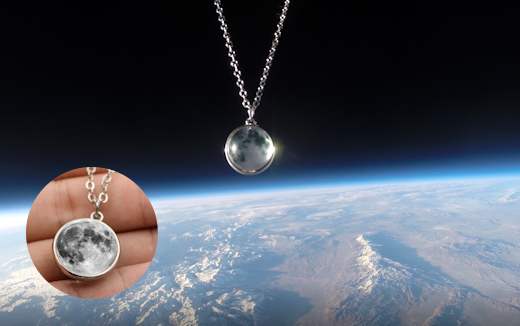
You can have it for $99.95. The students are selling these spherical glass pendants to support their cosmic ray ballooning program. Each one comes with a Valentine's card showing the pendant in flight and telling the story of its journey to the edge of space and back again.
Far Out Gifts: Earth to Sky Store
All sales support hands-on STEM education
Realtime Space Weather Photo Gallery