THE SOLAR WIND HAS ARRIVED: Arriving a day earlier than expected, a stream of solar wind is enveloping Earth's magnetic field. Its source is a hole in the sun's atmosphere. We're just in the outskirts of the stream now. NOAA forecasters estimate a 60% chance of G1-class geomagnetic storms on Jan. 24th when Earth moves deeper inside the high-speed flow. Aurora Alerts: SMS text, email.


A METEOROID HITS THE MOON DURING LUNAR ECLIPSE: On Jan. 21st at 04:41:43 UT, a meteoroid slammed into the Moon. We know this because so many people witnessed the explosion. It happened during a total eclipse of the Moon, visible from five continents. Dr. Fritz Helmut Hemmerich photographed the eclipse from the Canary Islands of Spain and captured the fireball:

"This is a happy shot!" says Hemmerich. "The shot just before and the shot just a few seconds later show nothing. The fireball was short-lived and I'm glad I caught it in this 2-second exposure."
Dozens of reliable images and videos of the impact have surfaced in the days since the eclipse. Analyzing one sharp image taken by Christian Fröschlin of the Netherlands, geologist Justin Cowart has estimated the selenographic coordinates of the impact site: 29.47S, 67.77W +/- 4km. This puts it just to the west of the lunar crater Lagrange H. NASA's Lunar Reconnaissance Orbiter may be able to use such coordinates to target its cameras and photograph the crater.

Meteoroids hit the Moon all the time. Literally. NASA has been observing impact flashes since 2005. Recently, other groups in Europe have joined the hunt. Flashes are typically recorded once every 2 to 3 hours of observing time. Impactors range in size from softballs to boulders, liberating energies equal to tons of TNT when they strike.

Above: The impact flash, photographed by Hunter McWilliams of Lubbock, Texas
The rare thing about this strike is that it was photographed during a full Moon, when lunar glare usually overwhelms the glow of any fireball. During the eclipse, Earth's shadow turned lunar day into almost-night for an hour, allowing the fireball to be seen.
Readers, were you taking pictures of the eclipse around 04:41 UT? Check your photos. You might have captured an explosion. Submit images here.
Realtime Eclipse Photo Gallery
FULL MOON VALENTINE'S GIFT: Poets, lovers, and artists have long known this simple truth: Nothing is more romantic than a full Moon. Now you can give the full Moon as a Valentine's Gift--the full Moon space pendant, that is. This one flew to the stratosphere on Dec. 26, 2018, onboard an Earth to Sky Calculus cosmic ray balloon:
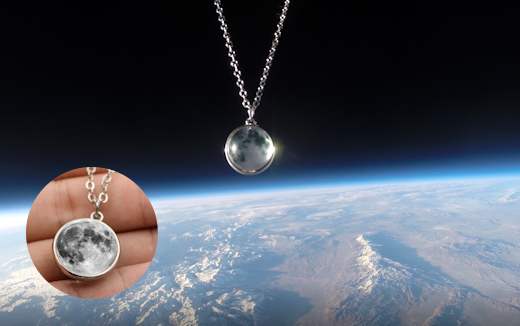
You can have it for $119.95. The students are selling these spherical glass pendants to support their cosmic ray ballooning program. Each one comes with a Valentine's card showing the pendant in flight and telling the story of its journey to the edge of space and back again.
Far Out Gifts: Earth to Sky Store
All sales support hands-on STEM education
Realtime Space Weather Photo Gallery