OLD-CYCLE SUNSPOT FACES EARTH: A relic of decaying Solar Cycle 24 may be seen on the solar disk today. Sunspot group AR2733 consists of more than a dozen dark cores scattered across 100,000 km of solar terrain. Its magnetic polarity identifies it as a member of the previous solar cycle--perhaps one of the last big sunspots of Solar Cycle 24. If you have a solar telescope, take a look. Free: SWx News

A SPRAY OF PINK AURORAS: A stream of high-speed solar wind is buffeting Earth's magnetic field. Last night, it produced a G1-class geomagnetic storm and a spray of pink auroras over Tromsø, Norway. "Oh yeah!" says Markus Varik, who photographed the display:


"It's pure art to be around Tromsø these days with fantastic Solar Minimum pink auroras dancing above our moonlit snowy landscapes," he says.
Most auroras are green--the color of oxygen atoms being struck by energetic particles from space between 100 km and 300 km above Earth's surface. Pink appears when energetic particles descend lower than usual, striking nitrogen molecules at the 100 km level and below. Both colors were visible over Tromsø on Jan. 24th.
There is anecdotal evidence that Solar Minimum produces an unusual number of pink and even white auroras. Why? The chemical and magnetic composition of solar wind during Solar Minimum may differ slightly from other phases of the solar cycle, producing its own palette of color.
"Do we get one more day of Solar Storm conditions?" wonders Varik. The answer is "yes." Earth will remain inside the stream of solar wind for another ~24 hours. Currently it is blowing nearly 600 km/s, a value that favors Arctic auroras. Aurora Alerts: SMS text, email.
FAR OUT VALENTINE'S GIFT: Valentine's Day is only 3 weeks away. Need a far-out gift? Consider the Valentine's Space Rose. This one flew 104,843 feet above the snow-capped Sierras of California on Jan. 19th:
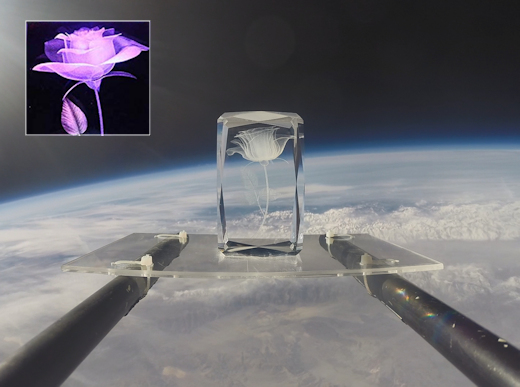
You can have it for $149.95. The rose is laser-etched into a block of optical-quality borosilicate crystal with the words "I Love You" curving below the stem. The students of Earth to Sky Calculus are selling these to support their cosmic ray ballooning program.
Each rose comes with a greeting card showing the item in flight and telling the story of its journey to the edge of space. Also included is an LED stand that fills the bloom with 4 luminous colors.
Far Out Gifts: Earth to Sky Store
All sales support hands-on STEM education
LUNAR PARHELIC CIRCLE: A parhelic circle is an unforgettable sight. Thin and pale, it circles the zenith in a majestic arc, always keeping the same distance above the horizon--crossing directly through the sun. On Jan. 24th, Sheila Wiwchar of Kaleida, Canada, saw a parhelic circle but, strangely, the sun was nowhere around. This parhelic circle was passing through the Moon:
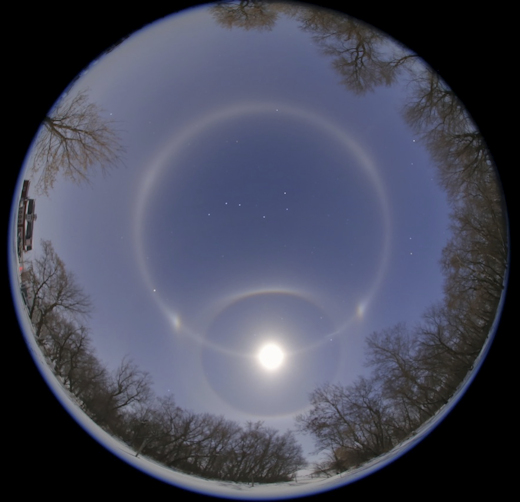
It was quite a sight," she says. "The circle filled the entire night sky! I set up a timelapse wondering if it would last, and it did." Her 3-hour video of the phenomenon is a must-see.
Parhelic circles are normally caused by sunlight reflecting from the vertical faces of ice crystals--millions of them floating in thin cirrus clouds spread almost evenly across the wide blue sky. In this case, bright moonlight performed the same trick. As Les Cowley notes in his authoritative web page on the subject, "the parhelic circle appears simple yet more ray paths contribute to it than in any other halo. Some are very intricate."
Note: Because this circle is caused by moonlight rather than sunlight, it is correctly called a "parselenic circle."
Realtime Eclipse Photo Gallery