WEEKEND SOLAR FLARE: On Saturday, Jan. 26th, sunspot AR2733 unleashed a C5-class solar flare--the strongest solar flare since Feb. 7, 2018. AR2733 is a member of decaying Solar Cycle 24; perhaps the explosion was the last gasp of the old solar cycle. The sunspot has since quieted and is now turning away from Earth. Free: SWx News.
SOLAR WIND, INCOMING: A large hole in the sun's atmosphere is facing Earth and spewing a stream of solar wind in our direction. Extreme ultraviolet telescopes onboard NASA's Solar Dynamics Observatory photographed the structure earlier today:

This is a "coronal hole"--a place where the sun's magnetic field opens up and allows solar wind to escape. It looks dark because the glowing-hot plasma normally contained there is missing. In this case, it's heading for Earth. Minor G1-class geomagnetic storms are likely when the gaseous material arrives on Jan. 31st or Feb. 1st.

We've seen this coronal hole before. It opened in the summer of 2018 and has been lashing Earth with solar wind approximately once a month since then. The last time solar wind from this coronal hole reached Earth, on Dec. 27th, it sparked an outburst of green above Alaska and "the best auroras of the season" over Iceland. Aurora Alerts: SMS text, email.
'INSANE' LIGHT PILLARS: Inside the Arctic Circle, the residents of Kiruna, Sweden, are accustomed to colorful lights in the night sky. Usually they are auroras, dancing in response to the solar wind. On Jan. 23rd, Mia Stålnacke witnessed a display that had nothing to do with space weather. "The light pillars were insane!" she says.

Light pillars are caused by ice crystals in the air which intercept manmade lights and spread them into colorful columns. No solar activity is required for the phenomenon. The only ingredients are ice and light pollution. Warm-orange colors arise from high pressure sodium lamps, while blue-white columns are caused by modern LED lamps.
"Conditions were just right for these spectacular pillars to appear with temperatures just below -20°C," says Stålnacke. "The shorter orange one on the right is the rising Moon."
Realtime Space Weather Photo Gallery
FLY ME TO THE MOONSTONE: Are you looking for a far-out Valentine's gift? Nothing says "I love you" like a moonstone from the edge of space. The students of Earth to Sky Calculus flew this moonstone wrapped in a hand-crafted sterling silver Celtic love knot 35.1 km (115,158 feet) above Earth's surface:
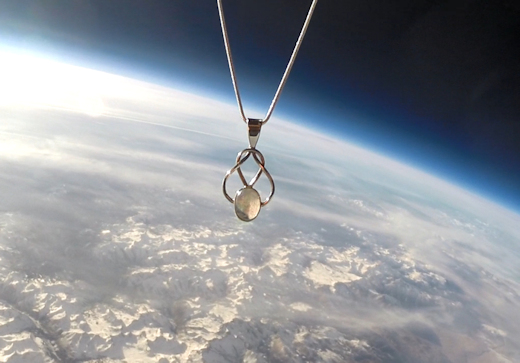
You can have it for $179.95. The students are selling these pendants to support their cosmic ray ballooning program. Each one comes with a greeting card showing the item in flight and telling the story of its journey to the edge of space. All sales support the Earth to Sky Calculus cosmic ray ballooning program and hands-on STEM research.
Far Out Gifts: Earth to Sky Store
All sales support hands-on STEM education