THE SOLAR WIND IS SUBSIDING: Earth is beginning to exit a stream of solar wind that has been buffting our planet's magnetic field since Jan. 31st. The stream is a wide one, so the exit will be slow. Solar wind speeds are expected to remain near 500 km/s through Feb. 4th, boosting the chances of Arctic auroras. Aurora Alerts: SMS text, email.
RED AURORAS OVER SCOTLAND: On Jan. 31st, a stream of solar wind hit Earth's magnetic field. Promptly, the Arctic Circle lit up with green auroras. Farther south, Daniel John Bowler of Glen Coe of Scotland saw red:

"Truely, it was the most amazing thing I've seen in many years," says Bowler. "The auroras were clear and visible to the naked eye--just phenomenal."
Auroras are normally green--the verdant glow of oxygen atoms excited by geomagnetic activity about 150 km above Earth's surface. Rare red auroras are also caused by oxygen atoms, but at higher altitudes between 150 km and 500 km. At those heights, the temperature and density of the atmosphere favors atomic transitions that emit red photons. Indeed, Bowler's photo shows red stacked on top of green just as theory predicts.
MAGNETIC UNREST IN ENGLAND: What happens when a stream of solar wind, traveling 1.3 million mph, strikes Earth's magnetic field? In Preston UK, Stuart Green has a magnetometer in his backyard to monitor such events. This chart from his device provides the answer:

"The chart clearly shows the arrival of a high-speed solar wind stream on Jan. 31st," says Green. "Magnetic unrest intensified over the following 24hrs to create a G1-class geomagnetic storm."
The squiggles in Green's chart represent changes in the local magnetic field caused by the buffeting of solar wind high overhead. They are the magnetic manifestation of auroras dancing at the same time around Arctic Circle.
"The sensor is buried in my garden about 0.5 meters below the surface in an East/West orientation," he explains. "This allows very sensitive (sub nanotesla) measurements of magnetic declination during geomagnetic storms. The plot shows the change in magnetic flux density in nanotesla occurring between readings every few minutes."
Realtime Space Weather Photo Gallery
VALENTINE'S GIFTS FROM THE EDGE OF SPACE: Valentine's Day is less than two weeks away. Looking for a far-out gift? Nothing says "I Love You" like a heart-shaped pendant from the edge of space:
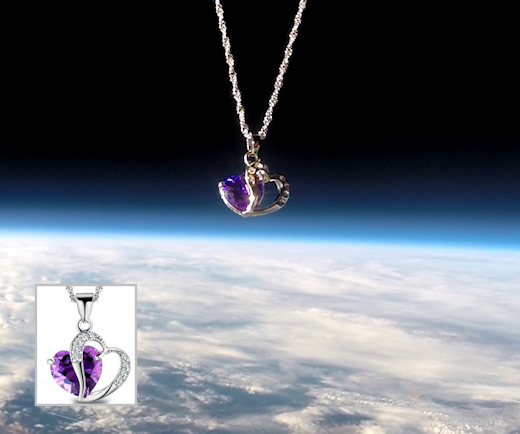
You can have it for $99.95. Using a giant helium balloon, the students of Earth to Sky Calculus flew this pendant to the stratosphere alongside an array of cosmic ray sensors. Now they're selling it as a fund-raiser for their cosmic ray monitoring program.
Edge of space pendants make great Valentine's gifts. Each one comes with a greeting card showing the jewelry in flight and telling the story of its journey to the stratosphere and back again.
Far Out Gifts: Earth to Sky Store
All sales support hands-on STEM education