THE NEXT GEOMAGNETIC STORM: A southern hole in the sun's atmosphere is spewing solar wind toward Earth. Minor G1-class geomagnetic storms are possible when the gaseous material arrives on Feb. 7th or (more likely) 8th. Arctic sky watchers should be alert for auroras. Aurora Alerts: SMS text, email.


SOUTH POLE AURORA VIDEO: Imagine living and working in darkness, 24 hours a day for 6 months out of every year. Robert Schwarz does just that. He's a professional telescope operator for the Keck Telescope Array at the Amundsen-Scott South Pole Station. And his hobby is astrophotography. For the past 14 winters, he has been taking pictures of the south polar night, witnessing scenes unlike anyplace else on Earth. His work is highlighted in a newly-released video entitled "South Pole | Night In Antarctica."
A longtime contributor to Spaceweather.com, Robert Schwarz is a pioneer in cold-weather astrophotography. At the South Pole, temperatures routinely drop below -70o C. Modern DSLR cameras are not made for such temperatures. LCD displays freeze instantly, mirror mechanisms get stuck, batteries fail, and time-lapse sequences often end after only 30 or 40 frames. To mitigate these problems, Robert has developed heated camera housings and motorized trackers with insulation, allowing his optics to follow the pirouette of the stars overhead even in deep Antarctic cold.
Cinematographers Christoph Malin and Martin Heck created the video using a year's worth of Schwarz's unique footage. They're looking forward to more. Right now, Robert is traveling to the South Pole for a record-setting 15th "overwinter," and of course he's taking his cameras. Stay tuned!
VALENTINE'S GIFTS FROM THE EDGE OF SPACE: Valentine's Day is only 9 days away. Nothing says "I love you" like a gift from the edge of space. Everything in the Earth to Sky Store is 10% off from now until Feb. 14th:
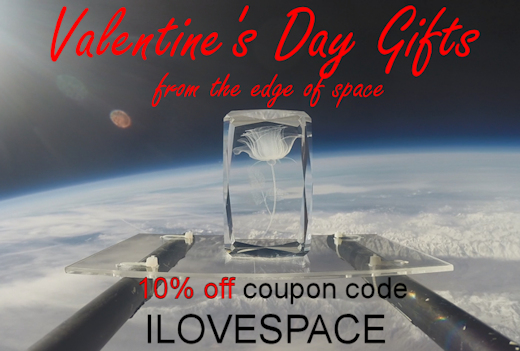
Everything in the store has been flown to the stratosphere onboard cosmic ray balloons, which the students of Earth to Sky Calculus launch approximately once a week to monitor atmospheric radiation. All sales support our cosmic ray ballooning program and help launch young scientists into research careers through hands-on STEM education.
Far Out Gifts: Earth to Sky Store
All sales support hands-on STEM education
WORLD CHAMPIONSHIP SUBSUN: As if one sun were not enough... Yesterday in Åre, Swede, skiers saw two: The regular sun and, stretched below it, a nearly blinding subsun. "I photographed it during downhill training for the upcoming alpine World Championships," reports Göran Strand.

"This subsun was really strong and it could be seen more or less the entire day due to all the ice crystals low in the air," says Strand.
Subsuns are a reflection of the actual sun from jewel-like ice crystals called "diamond dust." Ski resorts turn out to be an excellent place to see them. Atmospheric optics expert Les Cowley explains: "Modern snow blowers are the key. Many use biological material as highly effective nuclei on which the desired snow crystals grow. Near optical perfect halo forming crystals (simple long and short hexagonal prisms) are an unintended by-product. The latter grow very slowly on the nuclei downwind of the blowers."
Realtime Space Weather Photo Gallery