LONG RANGE FORECAST: Geomagnetic activity should remain low for the next week as Earth passes through a "slow zone" between two streams of solar wind. G1-class geomagnetic storms are possible on Feb. 19th when the solar wind speed picks up again. The gaseous materal is flowing from a long-lasting hole in the sun's atmosphere, due to return a week hence. Aurora Alerts: SMS text, email.

SURPRISE! ULTIMA THULE IS A PANCAKE: When NASA's New Horizons spacecraft flew past Ultima Thule last month, first-look images suggested the Kuiper Belt object was shaped like a snowman. New data just beamed back by the distant spacecraft tell a different story. It's a pancake! The puzzling revelation comes from images taken behind Ultima Thule, showing its crescent phase:

The outlines of the "crescent," in addition to the way background stars winked in and out behind Ultima Thule's nightside, allowed mission scientists to make a new 3D model of Ultima Thule.
Instead of a snowman, "it would be closer to reality to say Ultima Thule's shape is flatter, like a pancake," says New Horizons Principal Investigator Alan Stern of the Southwest Research Institute. "We've never seen something like this orbiting the sun."

Researchers thought they understood how Ultima Thule formed. Billions of years ago in the distant reaches of the infant solar system, a rotating cloud of icy bodies coalesced to form two small spheres. Those sphere eventually bumped and stuck together, forming a "snowman."
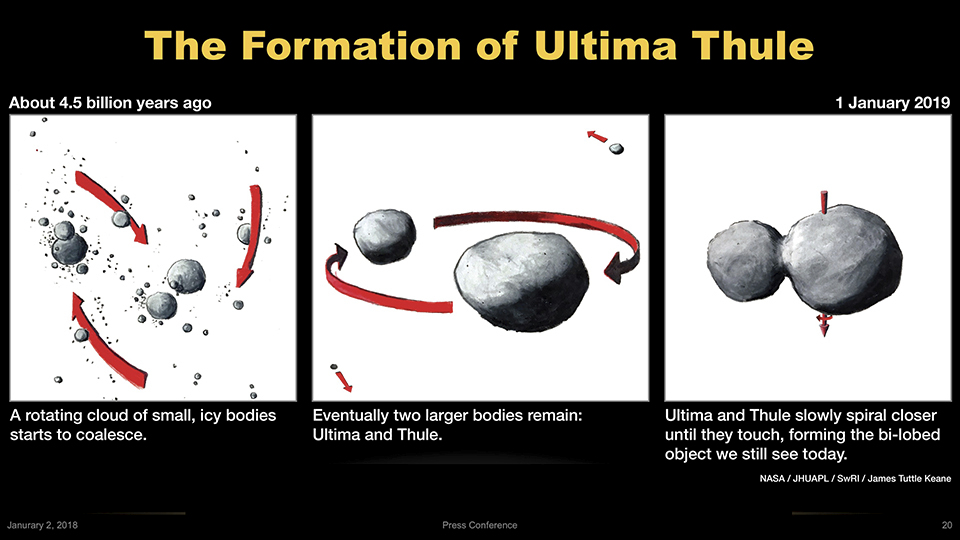
But... a pancake? "The new images are creating scientific puzzles about how such an object could even be formed," says Stern.
Realtime Space Weather Photo Gallery
VALENTINE'S GIFTS FROM THE EDGE OF SPACE: Valentine's Day is this week. Nothing says "I love you" like a gift from the edge of space. Everything in the Earth to Sky Store is 10% off from now until Feb. 14th:
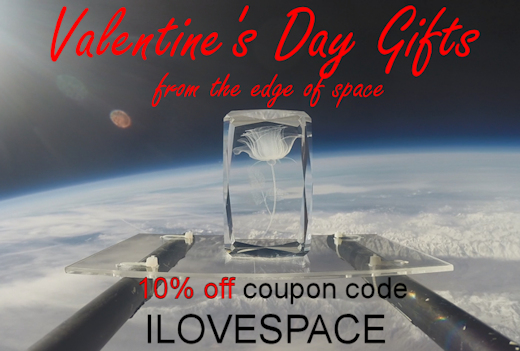
Everything in the store has been flown to the stratosphere onboard cosmic ray balloons, which the students of Earth to Sky Calculus launch approximately once a week to monitor atmospheric radiation. All sales support our cosmic ray ballooning program and help launch young scientists into research careers through hands-on STEM education.
Far Out Gifts: Earth to Sky Store
All sales support hands-on STEM education
DIAMOND DUST SKI HALO: Ski resorts are great places to see sun halos--rings of light that surround the sun when ice crystals fill the air. Spaceweather.com reader Yuichi Takasaka was skiing at the SilverStar Mountain Resort in British Columbia yesterday when he witnessed this specimen:

"It was pretty cold at -22.8C in the morning, but we went to ski anyway and were blessed with amazing scenery!" says Takasaka.
Ordinary sun halos are caused by ice crystals floating in high cirrus clouds."Ski halos," on the other hand, are formed by ice crystals near the ground, kicked into the air by the action of skis and snow-making machines.
A special type of crystal called "diamond dust" grows slowly downwind of ski-slope snow blowers. These man-made crystals tend to be more optically perfect than natural crystals in clouds, producing extra-bright, extra-sharp halos. A close look at Takasaka's picture shows specks of light in the air. Those are the glittering crystals of diamond dust which make ski halos so beautiful.

"Diamond dust created a 22-degree halo, sundogs, and a circumzenithal arc for more than 2 hours," says Takasaka. "After staring at the sky for so long, we were too frozen to keep skiing ... lol!"