GEOMAGNETIC UNREST TODAY: A stream of solar wind is buffeting Earth's magnetic field, and this is causing geomagnetic unrest around the poles. First contact with the gaseous material on Feb. 21st produced a "crazy outburst" of auroras over Alaska. More high-latitude auroras are possible on Feb. 22nd as solar wind speeds approach 500 km/s. Aurora Alerts: SMS text, email.
ATMOSPHERIC COSMIC RAYS ARE INCREASING: Cosmic rays in the stratosphere are intensifying for the 4th year in a row. This finding comes from a campaign of almost weekly high-altitude balloon launches conducted by the students of Earth to Sky Calculus. Since March 2015, there has been a ~13% increase in X-rays and gamma-rays over central California, where the students have launched hundreds of balloons.

The grey points in the graph are Earth to Sky balloon data. Overlaid on that time series is a record of neutron monitor data from the Sodankyla Geophysical Observatory in Oulu, Finland. The correlation between the two data sets is impressive, especially considering their wide geographic separation and differing methodologies. Neutron monitors have long been considered a "gold standard" for monitoring cosmic rays on Earth. This shows that our student-built balloons are gathering data of similar quality.
Why are cosmic rays increasing? The short answer is "Solar Minimum." Right now, the 11-year solar cycle is plunging into one of the deepest minima of the Space Age. The sun's weakening magnetic field and flagging solar wind are not protecting us as usual from deep-space radiation. Earth to Sky balloon launches in multiple countries and US states show that this is a widespread phenomenon.

Cosmic rays are of interest to anyone who flies on airplanes. The International Commission on Radiological Protection has classified pilots as occupational radiation workers because of cosmic ray doses they receive while flying. A recent study by researchers at the Harvard School of Public Health shows that flight attendants face an elevated risk of cancer compared to members of the general population. They listed cosmic rays as one of several risk factors. There are also controversial studies that suggest cosmic rays promote the formation of clouds in the atmosphere; if so, increasing cosmic rays could affect weather and climate.
A sharable verson of this story may be found here.
LOOKING FOR A FAR-OUT GIFT? Every time the students of Earth to Sky Calculus launch cosmic ray sensors to the stratosphere, they send a little something extra along for the ride. For example, this purple heart:
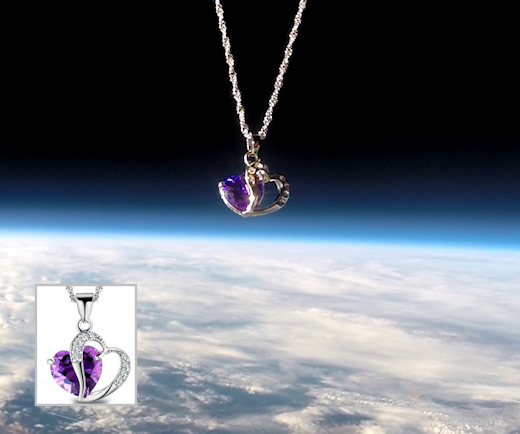
You can have it for $99.95. The students are selling these pendants as a fund-raiser for their cosmic ray monitoring program. They make great anniversary, birthday and Mother's Day gifts. Each pendant comes with a greeting card showing the jewelry in flight and telling the story of its journey to the stratosphere and back again.
Far Out Gifts: Earth to Sky Store
All sales support hands-on STEM education
PHYSICS OF AN EXPLODING COSMIC RAY BALLOON: On Nov. 14, 2018, the students of Earth to Sky Calculus launched a balloon to measure increasing levels of cosmic rays in the atmosphere. At the apex of the flight, the balloon exploded and the radiation sensors parachuted back to Earth. A video camera on top of the payload recorded the pop:

These images illustrate recent findings about the physics of exploding balloons. In a Physical Review Letter entitled "Popping Balloons: A Case Study of Dynamical Fragmentation," researchers from the Ecole Normale Supérieure in Paris report a series of laboratory experiments in which one balloon after another was popped and analyzed.
Basically, there are two ways a balloon can pop: along a single tear (the "opening regime") or along many tears (the "fragmentation regime"). This video shows the two regimes in action. Which way the balloon decided to pop depends on the stress in the rubber membrane. When the stress is low, it can be relieved with a single tear, but when the stress is high, many tears are required to do the job.
Space weather balloons explode in the fragmentation regime, and the new research explains why. When space weather balloons are launched, they measure no more than 6 to 8 feet in diameter. By the time they reach the stratosphere, they have stretched into a sphere as wide as a house. So much stress requires many tears to release.
More information about this research is available from the American Physical Society.