A MONTH WITHOUT SUNSPOTS? It could happen. The sun has been without spots since the beginning of February.Only 3 more days are necessary for an entire month of spotlessness. This long interval of blank suns is a sign that Solar Minimum is underway. This phase of the solar cycle brings extra cosmic rays, long-lasting holes in the sun's atmosphere, and strangely pink auroras. Aurora Alerts: SMS text, email.
CHANCE OF STORMS THIS WEEK: NOAA forecasters say there is a 50% chance of minor G1-class geomagnetic storms on Feb. 27th when a fast-moving stream of solar wind is expected to hit Earth's magnetic field. The gaseous material is flowing from a large hole in the sun's atmosphere, now facing our planet:


This is a coronal hole--a region in the sun's atmosphere where magnetic fields open up, allowing solar wind to escape. The wind is emerging at speeds near 500 km/s (1.1 million mph).
We've seen this coronal hole before. It opened in the summer of 2018 and has been spinning around as the sun rotates, lashing Earth with solar wind approximately once a month. The last time our planet felt its gaseous emissions, in late Jan. 2019, bright auroras surged around the Arctic Circle and some of the lights even spilled into the USA. More such displays are likely this week. Aurora Alerts: SMS text, email.
LOOKING FOR A FAR-OUT GIFT? Every time the students of Earth to Sky Calculus launch cosmic ray sensors to the stratosphere, they send a little something extra along for the ride. For example, this moonstone wrapped in a sterling silver Celtic love knot:
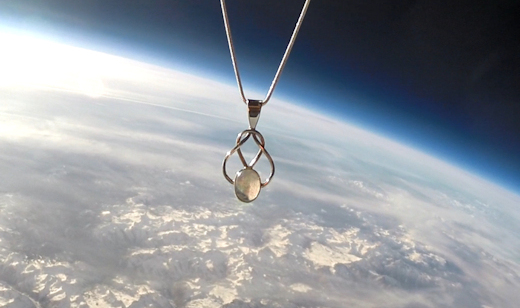
You can have it for $179.95. The students are selling these pendants as a fund-raiser for their cosmic ray monitoring program. They make great anniversary, birthday and Mother's Day gifts. Each pendant comes with a greeting card showing the jewelry in flight and telling the story of its journey to the stratosphere and back again.
Far Out Gifts: Earth to Sky Store
All sales support hands-on STEM education