SOLAR WIND STORM IN PROGRESS: The solar wind around Earth is now blowing faster than 550 km/s (1.2 million mph) as our planet enters a stream of plasma flowing from a wide hole in the sun's atmosphere. First contact with the stream on Feb. 28th sparked these auroras over Fairbanks, Alaska:

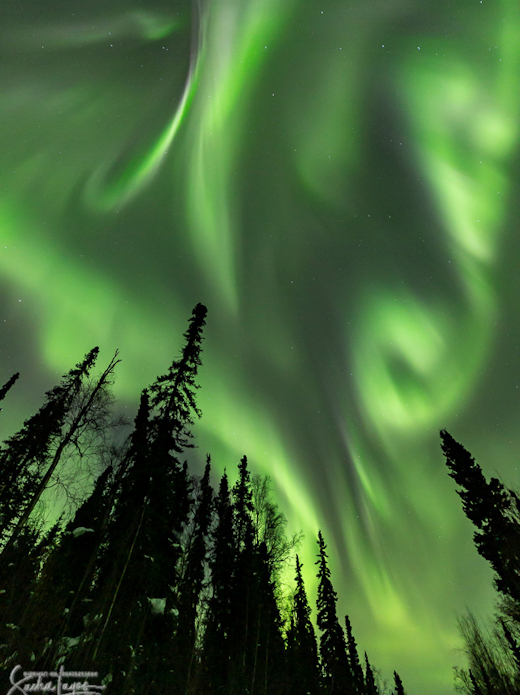
"It was a fantastic show with lots of curtains, different shapes and movement across the sky," reports photographer Sacha Layos.
The action of the solar wind is producing intermittent G1-class geomagnetic storms--a situation NOAA forecasters say could continue through March 1st while Earth remains inside the unusually wide stream. Auroras are possible not only around the Arctic Circle, but also with lesser brightness in northern-tier US states along a line from Maine to Washington. Aurora Alerts: SMS text, email.

By definition, geomagnetic storms cause our planet's magnetic field to shake and vibrate. Stuart Green is recording the action using a magnetometer in Preston, Lancashire, UK:
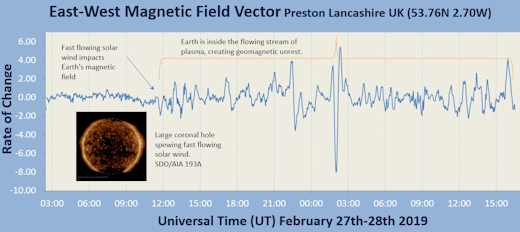
The squiggles in his chart represent changes in the local magnetic field caused by the buffeting of solar wind high overhead.
"These background rumblings are easily detectable on magnetometers around the world, including my own here in the UK," says Green."The sensor is buried in my garden about 0.5 meters below the surface. This allows very sensitive (sub nanotesla) measurements of magnetic declination during geomagnetic storms."
LOOKING FOR A FAR-OUT GIFT? Every time the students of Earth to Sky Calculus launch cosmic ray sensors to the stratosphere, they send a little something extra along for the ride. For example, this full Moon pendant:
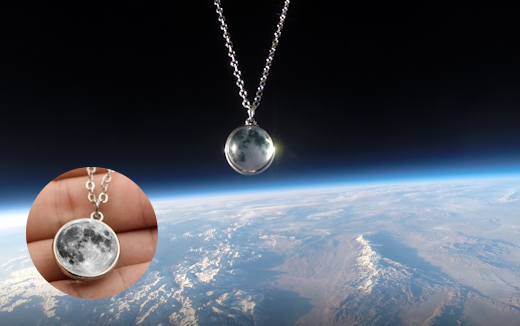
You can have it for $119.95. The students are selling these spherical glass pendants as a fund-raiser for their cosmic ray monitoring program. They make great anniversary, birthday and Mother's Day gifts. Each pendant comes with a greeting card showing the jewelry in flight and telling the story of its journey to the stratosphere and back again.
Far Out Gifts: Earth to Sky Store
All sales support hands-on STEM education
MYSTERY ON ICE: Last February, Mika-Pekka Markkanen went ice skating. "I came across this fantastic opportunity to skate on the natural untouched ice of a pond by the sea, surrounded by mountains on the Arctic island of Senja, Norway," says Markkanen. He stepped on the ice and witnessed a mystery that has stumped experts for more than a year.

"I noticed these strange colors near the sun's bright reflection on the ice," says Markkanen. "Luckily I had my camera and tripod so I managed to capture some nice photos of the phenomenon."
What caused the rainbow-like colors? Markkanen looked for help, contacting many experts in the field of color and atmospheric optics. "Nobody seemed to have clear answer. No one, not even Les Cowley, had ever even seen such a thing before!"
Finally, Dietrich Zawischa, a retired professor from the Institute of Theoretical Physics of Hannover University, may have found an answer. Using computer simulations, he modeled the colorful arcs as an interference pattern created by fine grains on the surface of the ice.
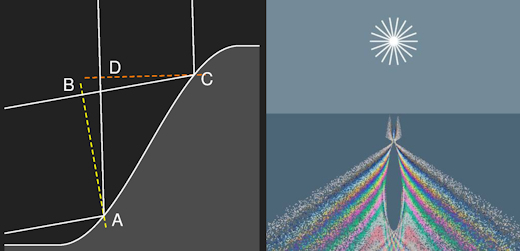
Above: Zawischa's model of the interference phenomenon. [full story]
"Such beautiful natural ice is very rare, and I guess that this optical effect is so uncommon that it has not yet been named," says Zawischa. "The grainy surface texture of the ice appears to be responsible for the colors. The texture might be due to snow falling just when the water was going to freeze while the weather was very calm. Presumably, rays of sunlight reflected by neighboring grains interfere."

"Although I was not able to reach full agreement between the photo and the simulation," says Zawischa, "I think we have captured the essential physics of the phenomenon."