THE SOLAR WIND CONTINUES TO BLOW: For the 3rd day in a row, Earth is inside a stream of solar wind flowing from a wide hole in the sun's atmosphere. With wind speeds topping 500 km/s (1.1 million mph), polar geomagnetic unrest and Arctic auroras are likely on March 2nd. Aurora Alerts: SMS text, email.

Update: Automated webcams in Sweden's Abisko National Park are seeing bright auroras right now:

"The green bands were visible right after sunset," says Chad Blakley of Lights over Lapland. "The sky wasn't even fully dark yet."
A MONTH WITHOUT SUNSPOTS: There are 28 days in February. This year, all 28 of them were spotless. The sun had no sunspots for the entire month of Feb. 2019. This is how the solar disk looked every day:
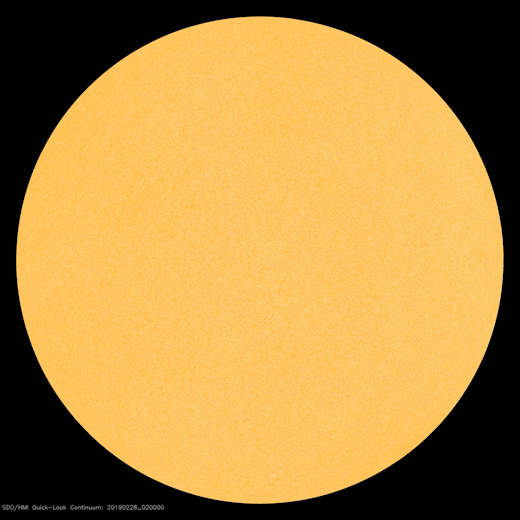
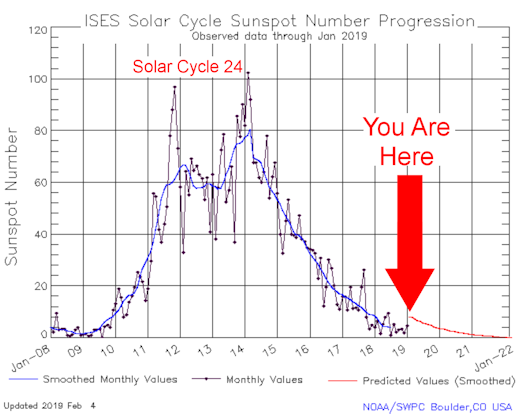
The last time a full calendar month passed without a sunspot was August 2008. At the time, the sun was in the deepest Solar Minimum of the Space Age. Now a new Solar Minimum is in progress and it is shaping up to be similarly deep. So far this year, the sun has been blank 73% of the time--the same as 2008.
Solar Minimum is a normal part of the solar cycle. Every ~11 years, sunspot counts drop toward zero. Dark cores that produce solar flares and CMEs vanish from the solar disk, leaving the sun blank for long stretches of time. These minima have been coming and going with regularity since the sunspot cycle was discovered in 1859.

However, not all Solar Minima are alike. The last one in 2008-2009 surprised observers with its depth and side-effects. Sunspot counts dropped to a 100-year low; the sun dimmed by 0.1%; Earth's upper atmosphere collapsed, allowing space junk to accumulate; the pressure of the solar wind flagged while cosmic rays (normally repelled by solar wind) surged to Space Age highs. All these things are happening again.
How does this affect us on Earth? The biggest change may be cosmic rays. High energy particles from deep space penetrate the inner solar system with greater ease during periods of low solar activity. Indeed, NASA spacecraft and space weather balloons are detecting just such an increase in radiation. Cosmic rays can alter the flow of electricity through Earth's atmosphere, trigger lightning, potentially alter cloud cover, and dose commercial air travelers with extra "rads on a plane."
As February ended, March is beginning ... with no sunspots. Welcome to Solar Minimum!
THE MOON, ENCASED IN CRYSTAL: On August 16, 2018, the students of Earth to Sky Calculus launched a cosmic ray balloon to the stratosphere. This unique laser-etched Moon cube went along for the ride, ascending to an altitude of 101,140 feet:
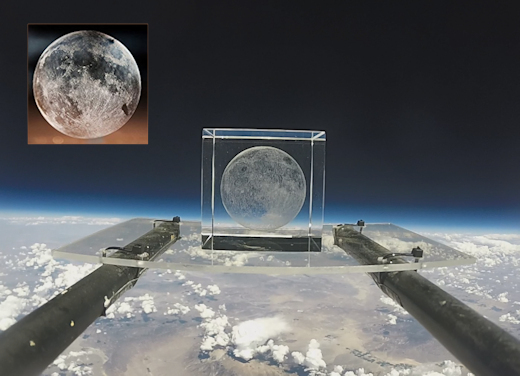
You can have it for $119.95. The students are selling these cubes as a fund-raiser for their cosmic ray ballooning program. It's an authentic representation of the Moon, with all of the craters, mountains and lava plains accurately portrayed.
Each Moon-cube comes with a unique gift card showing the item floating at the top of Earth's atmosphere. The interior of the card tells the story of the flight and confirms that this gift has been to the edge of space and back again.
Far Out Gifts: Earth to Sky Store
All sales support hands-on STEM education
MUST-SEE AURORA MOVIE: Last night, Feb. 28th, aurora tour guide Oliver Wright was standing on a groaning craggy pressure ridge on Sweden's frozen Lake Torneträsk when a geomagnetic storm erupted. Suddenly, the sky filled with dancing lights. Turn up the volume, hit play, and don't stop watching before the 1 minute mark
"This was one of my best nights guiding for Lights Over Lapland in more than 5 years," says Wright. "The geomagnetic storm predicted by Spaceweather.com really delivered. We had amazing aurora as soon as it started getting dark and it just got better and better. Just in this video there are 5 coronas!"