NO STORMS TODAY: Today, the solar wind blowing around Earth is fast but not stormy. Arctic sky watchers may see isolated episodes of bright auroras, but full-fledged geomagnetic storms are not expected on March 4th. Aurora Alerts: SMS text, email.
STEVE IS BACK: Northern spring is less than 3 weeks away. That means hot ribbons of plasma are starting to flow in Earth's magnetosphere. Ayumi Bakken saw one of them on Feb. 28th over Fairbanks, Alaska:

"STEVE is back!" says Bakken. "This skinny band of light appeared next to the Big Dipper for a few minutes, then faded out rapidly."
STEVE--short for "Strong Thermal Emission Velocity Enhancement"--was long thought to be a type of aurora borealis. But it's not. Auroras appear when particles rain down from space. STEVE, on the other hand, does not require any "rain." Satellite measurements show that it is a hot ribbon of gas speeding through the upper reaches of Earth's magnetic field faster than 10,000 mph.

Although STEVE is not an aurora, it often appears near auroras. Indeed, a G1-class geomagnetic storm was in progress at the time of Bakken's sighting, and he photographed many green auroras alongside the purple ribbon. "It was a gorgeous night," he says.

For reasons researchers don't fully understand, STEVE appears most often in weeks around equinoxes--that is, now. STEVE has returned, and we can expect to see more of him in the weeks ahead. Stay tuned.
ZODIACAL LIGHTS: Tonight, when the sun does down and the glow of sunset fades away, another glow will take its place--the Zodiacal Lights. They stretch upward from the western horizon forming a pale luminous triangle visible from places with exceptionally dark skies. Ruslan Merzlyakov photographed them on Feb. 23rd from Hjørring, Denmark:

"Absolutely incredible evening by the coast with, probably, brightest Zodiacal Lights I have ever seen--and explosion-shaped clouds!" says Merzlyakov.
When you see Zodiacal Lights, you've seen the backbone of our solar system. Zodiacal Lights are sunlight reflected from interplanetary dust. The pale glow traces the dusty plane through which all planets orbit, known to astronomers as the ecliptic plane. February, March and April are the best months to see evening Zodiacal Lights because the ecliptic plane juts over the horizon almost vertically.
Because Zodiacal Lights are faint, moonlight easily overwhelms them. Nights around the New Moon, therefore, favor their visibility. The next New Moons are due on March 6th and April 5th. Mark those dates on your calendar and label them "Zodiacal Lights."
Realtime Zodiacal Light Photo Gallery
THE MOON, ENCASED IN CRYSTAL: On August 16, 2018, the students of Earth to Sky Calculus launched a cosmic ray balloon to the stratosphere. This unique laser-etched Moon cube went along for the ride, ascending to an altitude of 101,140 feet:
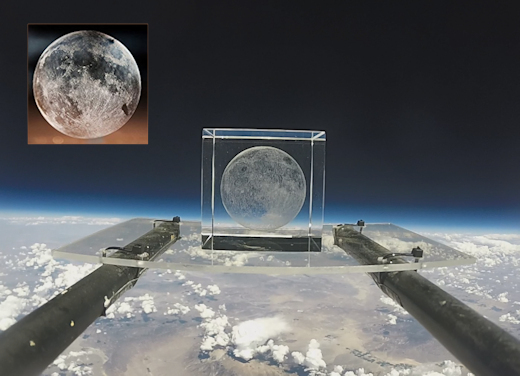
You can have it for $119.95. The students are selling these cubes as a fund-raiser for their cosmic ray ballooning program. It's an authentic representation of the Moon, with all of the craters, mountains and lava plains accurately portrayed.
Each Moon-cube comes with a unique gift card showing the item floating at the top of Earth's atmosphere. The interior of the card tells the story of the flight and confirms that this gift has been to the edge of space and back again.
Far Out Gifts: Earth to Sky Store
All sales support hands-on STEM education
Realtime Space Weather Photo Gallery
Realtime Aurora Photo Gallery