A GAP BETWEEN SOLAR WIND STREAMS: Earth is passing through a gap between solar wind streams. The next uptick in solar wind speed is expected on Mar. 7th when a minor hole in the sun's atmosphere moves into geoeffective position. Geomagnetic unrest on that date could spark Arctic auroras. Aurora Alerts: SMS text, email.
WHAT KIND OF SUNSPOT IS THAT? Today, a tiny sunspot is struggling to form in the sun's northern hemisphere. It is so small, it has not yet been numbered, and it may fade away before the day is done, leaving the sunspot number technically zero. Even if it vanishes, though, this funny little sunspot is worth mentioning because of its tilted magnetic field:

This is a magnetogram (magnetic map) of the sun obtained on March 5th by NASA's Solar Dynamics Observatory. The sunspot is inset. Note how its magnetic field is almost orthogonal to other patches of magnetism elsewhere on the solar disk.
Sunspots are islands of magnetism floating on the surface of the sun. Like all magnets, they have two poles, plus (+) and minus (-). Usually these poles are aligned almost parallel to the sun's equator. Today's sunspot is almost perpendicular.
Could this be a sunspot from the next solar cycle? Right now, Solar Cycle 24 is decaying into a deep Solar Minimum. Solar Cycle 25 is still in the offing. According to Hale's Law, sunspot magnetic fields reverse polarity between solar cycles. If this sunspot continues to grow--and if its magnetic axis tilts a bit to the right--Hale's Law would tag it as a member of Solar Cycle 25.
Solar cycles always mix together at their boundaries. Indeed, ephemeral sunspots possibly belonging to Solar Cycle 25 have already been reported on Dec. 20, 2016; April 8, 2018; and Nov. 17, 2018. Perhaps, when the day is done, we might add March 5, 2019, to the list. Stay tuned.
Realtime Space Weather Photo Gallery
CRYSTAL STARSHIP ENTERPRISE: Last month, the students of Earth to Sky Calculus launched the starship Enterprise to the stratosphere. Riding onboard a high-altitude cosmic ray balloon, the laser-etched crystal spaceship traveled 34.7 km (113,845 feet) above Earth's surface:
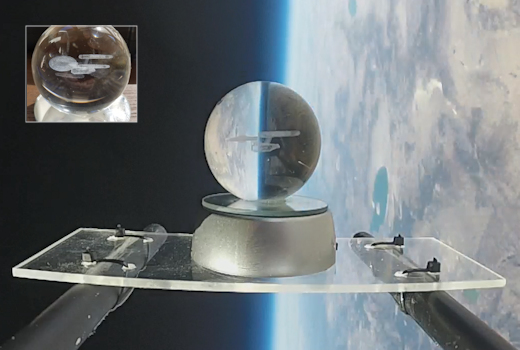
You can have it for $149.95. The students are selling the Enterprise to support their cosmic ray ballooning program. Each starship comes with a greeting card showing the item in flight and telling the story of its journey to the edge of space. Also included is a multi-colored LED illuminated stand (shown in the picture above). This creates a colorful visual effect and allows the Enterprise to be used as a far-out night light.
Far Out Gifts: Earth to Sky Store
All sales support hands-on STEM education
Realtime Space Weather Photo Gallery