A NEW SUNSPOT: The sun isn't blank any more. New sunspot AR2734 has emerged in the sun's northern hemisphere, breaking a string of 33 spotless days. This sunspot's magnetic field is a bit unusual, raising a question: Does it come from the next solar cycle? Probably not. The sunspot's relatively low latitude identifies it as a more likely member of old Solar Cycle 24. Aurora Alerts: SMS text, email.
A SHALLOW HOLE IN THE SUN'S ATMOSPHERE: For the next few days, Earth will feel the effects of a minor solar wind stream. The gaseous material is flowing from this irregular hole in the sun's atmosphere:

This is a coronal hole--a place where magnetic fields have peeled back, allowing solar wind to escape. In recent days, several small coronal holes have merged to form this sprawling structure. It is relatively shallow and the wind emerging from it may be weak and irregular. Solar wind speeds are likely to be greatest on March 8th when the body of the gaseous stream intersects Earth's orbit. Arctic sky watchers should be alert for auroras later this week. Aurora Alerts: SMS text, email.
Realtime Space Weather Photo Gallery
A METEORITE RETURNS TO SPACE: Meteorites usually come from space. On Feb. 23rd, the students of Earth to Sky Calculus sent one back. This rare pallasite meteorite hitched a ride onboard an Earth to Sky cosmic ray balloon, and it traveled 95,000 feet above Earth's surface:
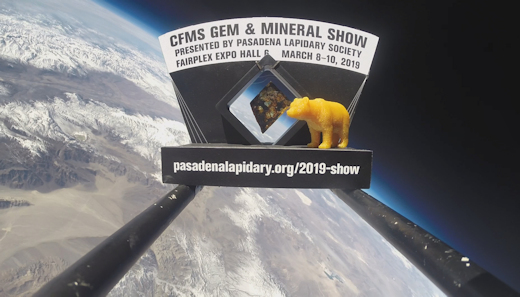
The launch was sponsored by the Pasadena Lapidary Society as part of their advertising campaign to promote the annual California Federation of Mineralogical Studies Gem and Mineral Show. If you're near Pomona, CA, On March 8th through 10th, check it out!
"The show will have kids' games, a raffle, silent auction, dispay cases, dealers selling gems, minerals, jewelry, meteorites and more," say the show's organizers. For further information, visit pasadenalapidary.org along with our Facebook and Twitter pages. The pallasite meteorite has been recovered from its landing site on the edge of Death Valley National Park and will be on display at the show."
Readers, if you would like to sponsor a cosmic ray balloon flight of your own, you can! Items sent to the edge of space are photographed, video recorded, recovered, and returned for a down-to-Earth price of $500.
Far Out Gifts: Earth to Sky Store
All sales support hands-on STEM education
Realtime Space Weather Photo Gallery