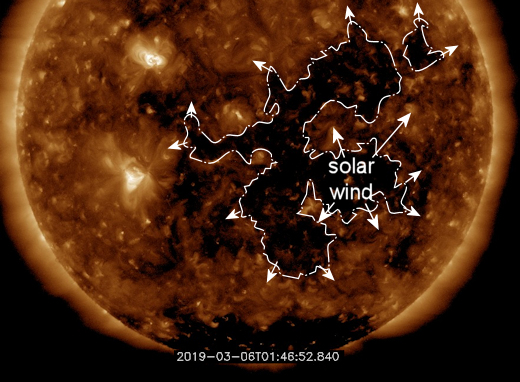
MINOR GEOMAGNETIC UNREST: For the next three days, one or more tenuous streams of solar wind could make weak connections with Earth's magnetic field. They are flowing from a patchy, shallow hole in the sun's atmosphere. Arctic auroras are possible on March 7th - 9th, intermittently waxing in brightness as the solar wind becomes occasionally geoeffective. Aurora Alerts: SMS text, email.
A REALLY WEIRD SOLAR ECLIPSE: Earlier today, NASA's Solar Dynamics Observatory (SDO) observed an eclipse of the sun--a strange kind of eclipse that you can only see while orbiting Earth. The black disk of the New Moon passed in front of the sun, reversed course, and did it again:

During the eclipse, which lasted just over 4 hours, as much as 82% of the sun was covered. Technically, that makes it an annular solar eclipse, not total. At maximum, an annulus or "ring of fire" completely surrounded the Moon.
The strange "double-dip" motion of the Moon across the sun is a result of orbital mechanics. Both SDO and the Moon are orbiting Earth, but at different speeds. SDO's velocity of ~3 km/s is faster than the Moon's velocity of 1 km/s. SDO thus overtakes the Moon first in one direction, then the other, during the long eclipse.
High-resolution images of the eclipse reveal that the Moon is not perfectly smooth. The little bumps and irregularities you see are lunar mountains backlit by solar plasma:
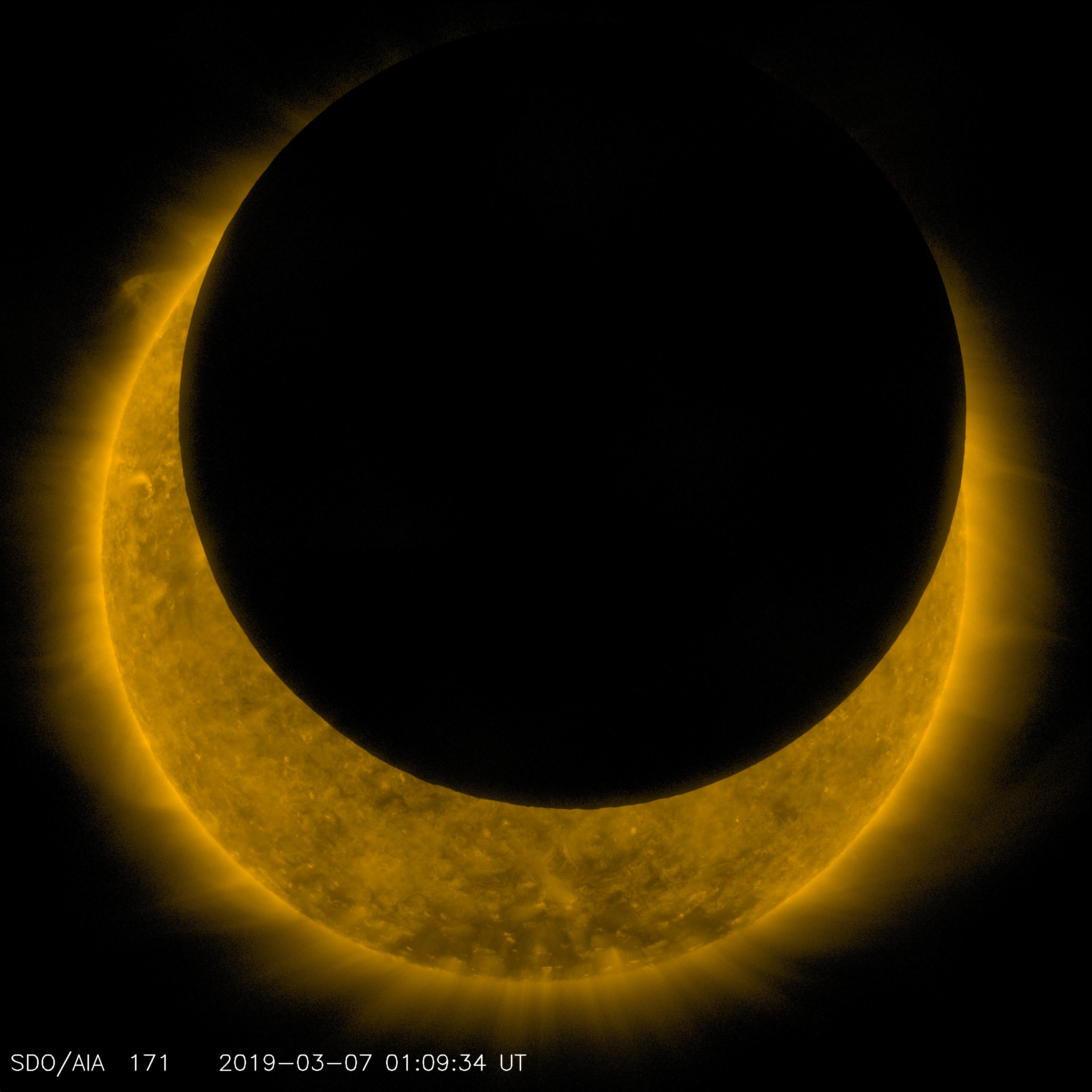
Images like these have practical value to the SDO science team. The sharp edge of the lunar disk helps researchers measure the in-orbit characteristics of the telescope--e.g., how light diffracts around the telescope's optics and filter support grids. Once these are calibrated, it is possible to correct SDO data for instrumental effects and sharpen images of the sun even more than before.
Realtime Space Weather Photo Gallery
A METEORITE RETURNS TO SPACE: Meteorites usually come from space. On Feb. 23rd, the students of Earth to Sky Calculus sent one back. This rare pallasite meteorite hitched a ride onboard an Earth to Sky cosmic ray balloon, and it traveled 95,000 feet above Earth's surface:
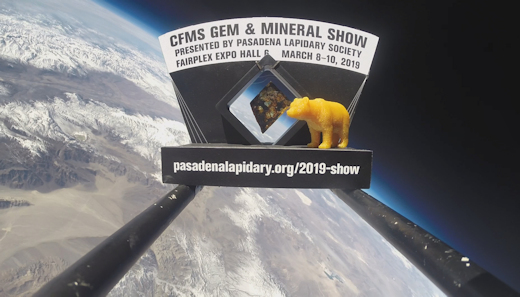
The launch was sponsored by the Pasadena Lapidary Society as part of their advertising campaign to promote the annual California Federation of Mineralogical Studies Gem and Mineral Show. If you're near Pomona, CA, On March 8th through 10th, check it out!
"The show will have kids' games, a raffle, silent auction, display cases, dealers selling gems, minerals, jewelry, meteorites and more," say the show's organizers. For further information, visit pasadenalapidary.org along with our Facebook and Twitter pages. The pallasite meteorite has been recovered from its landing site on the edge of Death Valley National Park and will be on display at the show."
Readers, if you would like to sponsor a cosmic ray balloon flight of your own, you can! Items sent to the edge of space are photographed, video recorded, recovered, and returned for a down-to-Earth price of $500.
Far Out Gifts: Earth to Sky Store
All sales support hands-on STEM education
Realtime Space Weather Photo Gallery