CHANCE OF STORMS TODAY: NOAA forecasters say there is a 55% chance of G1-class geomagnetic storms on March 11th when Earth has a close encounter with two coronal mass ejections (CMEs). The solar storm clouds left the sun on March 8th when sunspot AR2734 produced a C1-class solar flare. Neither CME is heading directly for Earth, but a double glancing blow could produce beautiful Arctic auroras. Aurora Alerts: SMS text, email.

ANOTHER EXPLOSION IN SUNSPOT AR2734: For such a small sunspot, AR2734 is surprisingly active. On March 10th, the sunspot's magnetic field became unstable and erupted for the second time in as many days. NASA's Solar Dynamics Observatory caught the sunspot hurling a dark filament of magnetism into space. Play the video and keep an eye on the circled material:

NOAA analysts have examined the trajectory of the filament and surrounding ejecta. They say it is unlikely to hit Earth. Nevertheless, stormy space weather is likely on March 11-13 as Earth passes close to coronal mass ejections (CMEs) ejected from sunspot AR2734 on March 8th.
What's next? AR2734 is now turning away from Earth, so future eruptions, if any, will probably not be geoeffective. Solar Minimum is set to resume in the week ahead. Aurora Alerts: SMS text, email.
A MOONSTONE AT THE EDGE OF SPACE: Are you looking for a far-out gift? Nothing says "I love you" like a moonstone from the edge of space. Last month, the students of Earth to Sky Calculus flew this moonstone wrapped in a sterling silver Celtic love knot 34.1 km (111,877 feet) above Earth's surface:
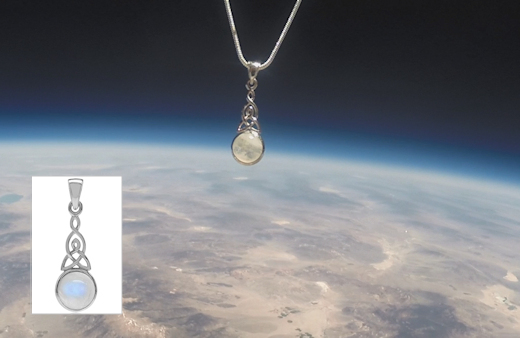
You can have it for $139.95. The students are selling these pendants to support their cosmic ray ballooning program. Each one comes with a greeting card showing the item in flight and telling the story of its journey to the edge of space. Sales support the Earth to Sky Calculus cosmic ray ballooning program and hands-on STEM research.
Far Out Gifts: Earth to Sky Store
All sales support hands-on STEM education
Realtime Space Weather Photo Gallery