SOLAR WIND, INCOMING: A canyon-shaped hole in the sun's atmosphere is facing Earth, and it is spewing a stream of solar wind in our direction. Minor G1-class geomagnetic storms are possible when the gaseous material arrives on March 15th. Arctic sky watchers, warm up your cameras. Aurora Alerts: SMS text, email.


HAPPY PI DAY: March 14th (3.14) is  day, and all around the world pi-philes are celebrating one of the most compelling and mysterious constants of Nature. Pi appears in equations describing the orbits of planets, the colors of auroras, the structure of DNA. The value of is woven into the fabric of life, the universe and ... everything.
Humans have struggled to calculate for thousands of years. Divide the circumference of a circle by its diameter; the ratio is . Sounds simple, but the devil is in the digits. While the value of is finite (a smidgen more than 3), the decimal number is infinitely long:
3.1415926535897932384626433832795
02884197169399375105820974944592307
81640628620899862803482534211706...more
Supercomputers have succeeded in calculating more than 2700 billion digits and they're still crunching. The weirdest way to compute : throw toothpicks at a table or frozen hot dogs on the floor. Party time.
NEUTRONS DETECTED ON COMMERCIAL AIRPLANE FLIGHTS: Long lines. Narrow seats. Baggage fees. You recognize this list. It's the downside of flying on modern commercial airlines. And now we have a new item to add: neutrons.
Spaceweather.com and Earth to Sky Calculus have just completed a 5-continent survey of cosmic ray neutrons at aviation altitudes. From Dec. 2018 through Feb. 2019, Hervey Allen of the University of Oregon's Network Startup Resource Center carried Earth to Sky radiation sensors including neutron bubble chambers onboard commercial flights from North America to Europe, Africa, South America and Asia. Neutrons from deep space were detected on every flight.

Hervey logged 83 hours in the air as he traveled 41,500 miles above 30,000 feet. For reference, that's almost twice the circumference of the Earth. The entire time, he gathered data on X-rays, gamma-rays and neutrons in an energy range (10 keV to 20 MeV) similar to that of medical radiology devices and "killer electrons" from the Van Allen Radiation Belts.
The results were eye-opening. During the trip, Hervey recorded 230 uGy (microGrays) of cosmic radiation. That's about the same as 23 panoramic dental x-rays or two and a half chest X-rays. Moreover, 41% of the dose came in the form of neutrons. This confirms that cosmic-ray neutrons are abundant at aviation altitudes and must be considered in any discussion of "Rads on a Plane."

Each bubble represents a cosmic ray neutron penetrating the chamber (left) on board a flight from San Francisco to South Korea and (right) crossing the Atlantic Ocean.
Researchers have long known that cosmic rays penetrate airplanes. Our own 3-year survey of global radiation shows that X-rays and gamma-rays at aviation altitudes are typically 50 times stronger than sea level. This new survey focuses on neutrons, a more potent type of radiation from deep space. Studies show that neutrons can be ten times more effective at causing biological damage compared to X-rays and gamma-rays in the same energy range. Neutrons are so effective, they are used for cancer therapy, killing tumors better than other forms of radiation.
Should we be worried about Hervey? Although he absorbed a lot of radiation during the survey, he did so slowly. Hervey's whole body dose was spread out over 14 flights and 3 months–unlike, say, a dental X-ray which is localized to the jaw and delivered in a split-second. Slow delivery gives the body time to respond, repair damage, and move on without obvious health effects. On the other hand, at least one study shows that low-dose radiation received over a long period of time may slightly increase the risk of leukaemia, while flight attendants have been found to have a higher risk of cancer than the general population.

Left: Neutrons detected while flying from Europe to Accra, Ghana. Right: Ground-level measurements in Ghana with giant ant mounds in the background.
Our survey also revealed some geographical variations. Generally speaking, neutron radiation was stronger near the Arctic Circle and weaker near the equator. It was weakest of all, however, in flights over Chile as the aircraft skirted the South Atlantic Anomaly. We will be investigating these variations with additional flights in the near future. Stay tuned!
A sharable version of this story is available here.
A MOONSTONE AT THE EDGE OF SPACE: Are you looking for a far-out gift? Nothing says "I love you" like a moonstone from the edge of space. Last month, the students of Earth to Sky Calculus flew this moonstone wrapped in a sterling silver Celtic love knot 34.1 km (111,877 feet) above Earth's surface:
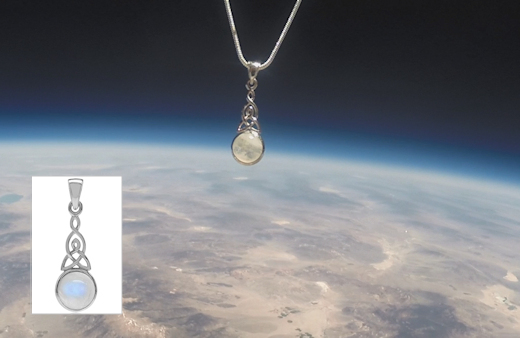
You can have it for $139.95. The students are selling these pendants to support their cosmic ray ballooning program. Each one comes with a greeting card showing the item in flight and telling the story of its journey to the edge of space. Sales support the Earth to Sky Calculus cosmic ray ballooning program and hands-on STEM research.
Far Out Gifts: Earth to Sky Store
All sales support hands-on STEM education
Realtime Space Weather Photo Gallery