A VERY SLOW-MOVING CME: On Mar. 12th, the Solar and Heliospheric Observatory detected a faint coronal mass ejection (CME) slowly billowing away from the sun. Five days later, the storm cloud may be approaching Earth. How slow is it? Slower than the surrounding solar wind. In fact, the solar wind may be dragging the CME toward us. The impact of this leisurely CME could occur on Mar. 17th adding its effect to the geomagnetic storms already underway. See below! Aurora Alerts: SMS text, email.
A CRACK IN EARTH'S MAGNETIC FIELD: During the late hours of March 16th, a crack opened in Earth's magnetic field--not a big one, but big enough to cause a G1-class geomagnetic storm. Rayann Elzein witnessed the resulting auroras over Utsjoki, Finland:


"The auroras appeared as soon as twilight ended (actually a bit before)," says Elzein. "It was a magnificent display!"
This storm was not predicted, yet it comes as no surprise. The vernal equinox is only a few days away, and at this time of year cracks often form in Earth's magnetic field. Solar wind can pour through the gaps to fuel bright displays of Arctic lights.
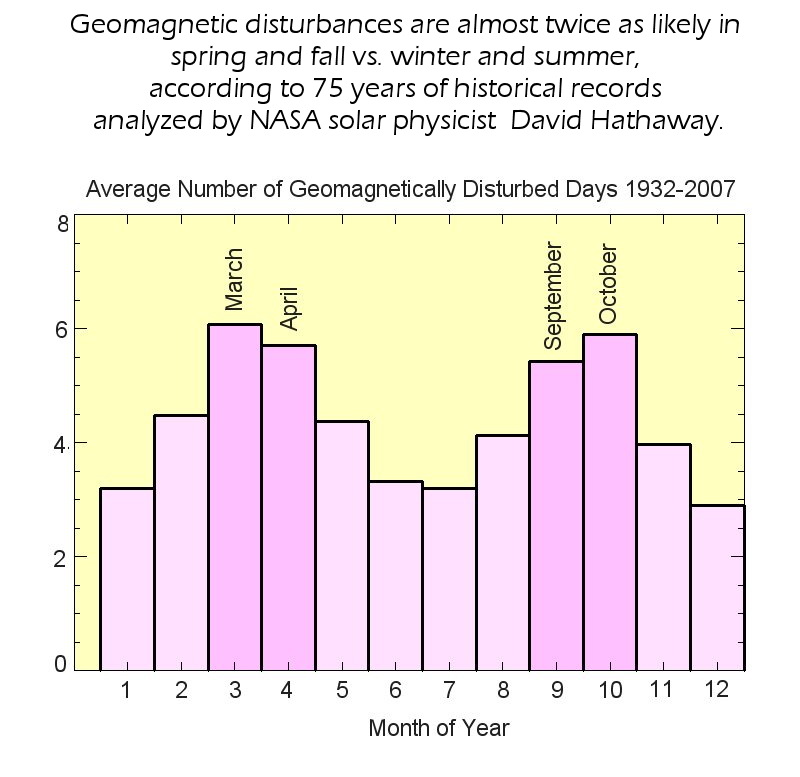
This is called the the "Russell-McPherron effect," named after the researchers who first explained it. The cracks are opened by the solar wind itself. South-pointing magnetic fields inside the solar wind oppose Earth's north-pointing magnetic field. The two, N vs. S, partially cancel one another, weakening our planet's magnetic defenses. This cancellation can happen at any time of year, but it happens with greatest effect around the equinoxes. Indeed, a 75-year study shows that March is the most geomagnetically active month of the year, followed closely by September-October–a direct result of "equinox cracks."
Northern spring is just around the corner. Stay tuned for green. Aurora Alerts: SMS text, email.
MOTHER'S DAY SPACE PENDANT: Tell Mom how much you love her -- to the Moon and Back! On March 5, 2019, the students of Earth to Sky Calculus launched an array of cosmic ray sensors to the edge of space onboard a helium balloon. This Mother's Day pendant went along for the ride:

The silvery crescent declares "I love you to the Moon and Back" and surrounds a 14K gold plated heart labeled "Mom."
You can have it for $119.95. The students are selling these pendants to support their cosmic ray ballooning program. Each one comes with a greeting card showing the item in flight and telling the story of its journey to the edge of space. Sales support the Earth to Sky Calculus cosmic ray ballooning program and hands-on STEM research.
Far Out Gifts: Earth to Sky Store
All sales support hands-on STEM education
Realtime Space Weather Photo Gallery