CME IMPACT: A CME has just hit Earth's magnetic field. It passed the DSCOVR satellite at 20:43 UT on March 24th and reached our planet soon thereafter. First-look data suggest that this is a minor blow which will, at most, spark G1-class geomagnetic storms in the hours ahead. Arctic sky watchers should be alert for auroras. Aurora alerts: SMS text, email.

HOLES IN THE SUN'S ATMOSPHERE: Even if today's CME does not spark a geomagnetic storm, auroras may still be in the offing. A network of holes in the sun's atmosphere is facing Earth, spewing a filamentary stream of solar wind in our direction:

The gaseous material could arrive as early as March 26th, although March 27-28 is more likely. The approaching stream is not as potent as a CME, but it could be geoeffective anyway. At this time of year, cracks are opening Earth's magnetic field--a phenomenon known as the "Russell-McPherron effect." Even gentle gusts of solar wind can ignite bright auroras around the Arctic Circle.
A GIFT FROM THE EDGE OF SPACE: Last month, the students of Earth to Sky Calculus launched the starship Enterprise to the stratosphere. Riding onboard a high-altitude cosmic ray balloon, the laser-etched crystal spaceship traveled 34.7 km (113,845 feet) above Earth's surface:
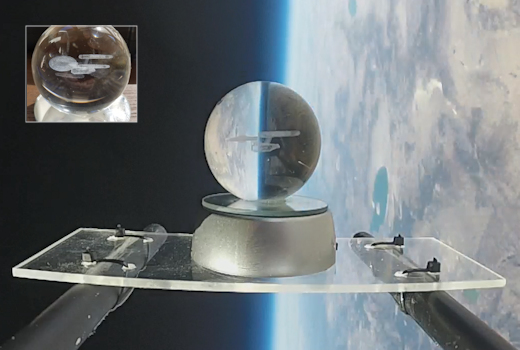
You can have it for $149.95. The students are selling the Enterprise to support their cosmic ray ballooning program. Each starship comes with a greeting card showing the item in flight and telling the story of its journey to the edge of space. Also included is a multi-colored LED illuminated stand (shown in the picture above). This creates a colorful visual effect and allows the Enterprise to be used as a far-out night light.
Far Out Gifts: Earth to Sky Store
All sales support hands-on STEM education
Realtime Space Weather Photo Gallery