SLIGHT CHANCE OF STORMS: Later today, March 27th, a co-rotating interaction region (CIR) is expected to hit Earth's magnetic field. CIRs are transition zones between slow- and fast-moving streams of solar wind. They contain shock-like density gradients and compressed magnetic fields that often do a good job sparking Arctic auroras. A high-speed stream of solar wind following behind the CIR could cause G1-class geomagnetic storms on March 28th. Aurora alerts: SMS text, email.

THE EDGE OF THE SUN IS FUZZY: Usually, when we say "disk," we mean a circular object with a sharply-defined edge. The solar disk, however, is different. Its edge is fuzzy. Alan Friedman of Buffalo New York photographed the sun on March 26th, and this is what he found:

"Old Sol was sporting a feebly growing down," says Friedman.
This is a solar prominence--a forest of magnetic loops growing out of the sun's surface. Each loop contains a ragged mass of hot-glowing plasma. Viewed over the edge of the sun, they are easy to see against the velvet-black canvas of space beyond.
Today, NASA's Solar Dynamics Observatory is monitoring no fewer than six tall prominences: finder chart. If you have a solar telescope, take a look!

A GIFT FROM THE EDGE OF SPACE: Are you looking for a far-out gift? Nothing says "I love you" like a moonstone from the edge of space. On Jan 27th, the students of Earth to Sky Calculus flew this moonstone wrapped in a hand-crafted sterling silver Celtic love knot 35.1 km (115,158 feet) above Earth's surface:
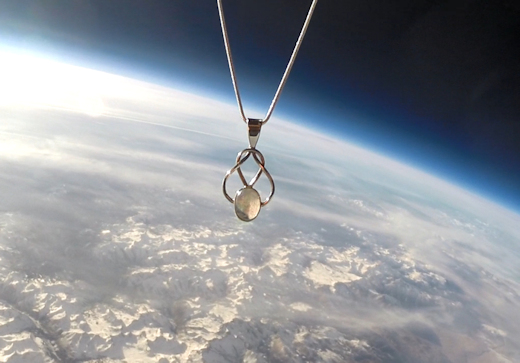
You can have it for $179.95. The students are selling these pendants to support their cosmic ray ballooning program. Each one comes with a greeting card showing the item in flight and telling the story of its journey to the edge of space. All sales support the Earth to Sky Calculus cosmic ray ballooning program and hands-on STEM research.
Far Out Gifts: Earth to Sky Store
All sales support hands-on STEM education
Realtime Space Weather Photo Gallery