SOLAR WIND, INCOMING: A southern hole in the sun's atmosphere is facing Earth and spewing a stream of solar wind in our direction. Estimated time of arrival: April 3rd. Minor geomagnetic storms and Arctic auroras are possible when the gaseous material arrives. Aurora alerts: SMS text, email.

SOMETHING NEW ON THE SUN: A new sunspot is growing in the sun's northern hemisphere. Provisionally numbered AR2737, it is inset in this magnetic map of the sun from NASA's Solar Dynamics Observatory:

Sunspots are, essentially, islands of magnetism floating on the surface of the sun. Like all magnets they have poles, + and -. Sunspot AR2737 has a simple bipolar magnetic structure that identifies it as a member of old Solar Cycle 24.
There is a hint of a third pole (-) growing in this sunspot. If it continues to develop, creating a mixture of magnetic polarities, the region could become active. Mixed-polarity magnetic fields can criss, cross, and explode--a process known as "magnetic reconnection" underlying solar flares. So far, however, AR2737 is quiet.

Realtime Space Weather Photo Gallery
DEEP-SKY AURORAS IN THE USA: On March 31st, a minor stream of solar wind buffeted Earth's magnetic field. The gentle pressure was just enough to spark faint auroras over the US-Canadian border--pale and barely visible to the human eye, but an easy target for digital cameras. Kevin Palmer photographed the display from Lake DeSmet, Wyoming:

"I did not expect to see any auroras last night, so this was a pleasant surprise," says Palmer.
Brendan Lawrence of Kinsey, Montana, saw them, too. "I noticed the northern sky looking a bit brighter than usual," says Lawrance. "A 20-second exposure using my Nikon D800 confirmed that the aurora borealis was indeed visible all the way into southeastern Montana!"
These are called "deep sky auroras" because like other deep-sky objects (e.g., galaxies and nebulae) they are best seen using optics and timed exposures. More of them could be in the offing. A solar wind stream is approaching Earth and expected to arrive on April 3rd or 4th. A nearly-new Moon on those dates will make the night sky dark enough for long exposures. Photographers, grab your cameras and be alert for auroras.
A note to Spaceweather ALERT subscribers: Deep-sky auroras occur mainly during weak geomagnetic storms. To maximize your chances of photographing the phenomenon, sign up for the Pro Plan of Space Weather Alerts. When you receive a text message saying that the K-index is 4 or 5, deep sky auroras may be overhead.
A GIFT FROM THE EDGE OF SPACE: On August 16, 2018, the students of Earth to Sky Calculus launched a cosmic ray balloon to the stratosphere. This laser-etched Moon cube went along for the ride, ascending to an altitude of 101,140 feet:
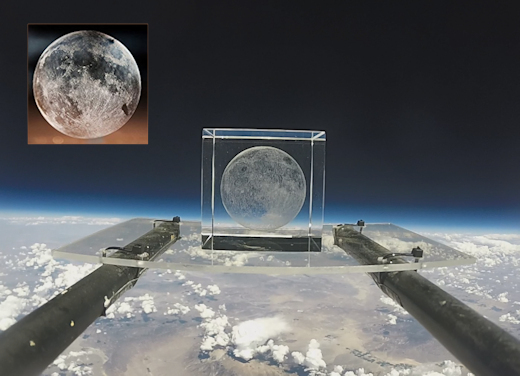
You can have it for $119.95. The students are selling these cubes as a fund-raiser for their cosmic ray ballooning program. It's an authentic representation of the Moon, with all of the craters, mountains and lava plains accurately portrayed.
Each Moon-cube comes with a unique gift card showing the item floating at the top of Earth's atmosphere. The interior of the card tells the story of the flight and confirms that this gift has been to the edge of space and back again.
Far Out Gifts: Earth to Sky Store
All sales support hands-on STEM education
Realtime Space Weather Photo Gallery