SOLAR MINIMUM IS A TERRIBLE TIME TO BLOW UP A SATELLITE: Note to space powers: If you're going to blow a satellite to bits, solar minimum is a terrible time to do it. India is grappling with this important truth as debris from their March 27th anti-satellite weapons test spreads through space. Get the full story.
THE SOLAR WIND HAS ARRIVED: Earth is entering a stream of solar wind flowing from a southern hole in the sun's atmosphere. The gaseous material, flowing faster than 450 km/s, is sparking auroras around the Arctic Circle. John David McKinnon photographed this display from Slave River in the Northwest Territories of Canada:


"Wave after wave of active auroras danced across the sky, with ever changing intensity and colour," says McKinnon. "T'was an extremely beautiful night."
Elevated solar wind speeds should continue for the next ~24 hours as Earth passes through the stream. Full-fledged geomagnetic storms are not expected from this relatively minor stream, but the Arctic aurora show will continue. Aurora alerts: SMS text, email.
SOLAR PROMINENCES: If you have a safe solar telescope, take a look at the sun today. Prominences are leaping up from the edge of the sun, some of them taller than Earth itself. Philippe Tosi photographed the action on April 4th from Nîmes, France:

"I used a 204 mm F/10 H-alpha refractor," he explains. "A picture of Earth was added for scale. These are pretty big."
Prominences are plumes of glowing-hot plasma held above the surface of the sun by powerful magnetic fields. Sometimes they become unstable and collapse, dumping their load of plasma onto the solar surface below. This can cause an explosion--a type of solar flare called a Hyder flare.
The prominences Tosi photographed do not, however, appear to be unstable. That means they are still there, waiting for astronomers to photograph. Submit your images here.
Realtime Space Weather Photo Gallery
A GIFT FROM THE EDGE OF SPACE: It's sterling silver and it comes from space. On March 5th, the students of Earth to Sky Calculus flew a cosmic ray balloon to the stratosphere, more than 94,000 feet above Earth's surface. This "Loving Hands" pendant went along for the ride:
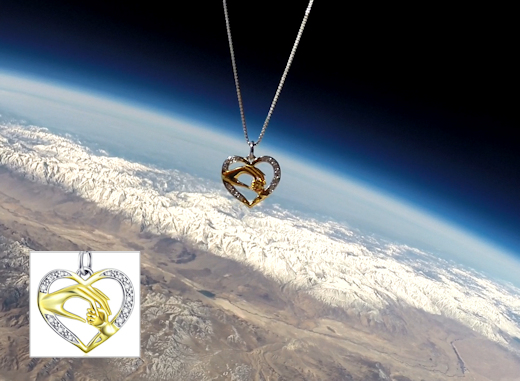
You can have one for $129.95. They make great Mother's Day gifts. The students are selling these pendants as a fund-raiser for their cosmic ray monitoring program. All proceeds support atmospheric radiation measurements and hands-on STEM education.
Each pendant comes with a greeting card showing the jewelry in flight and telling the story of its journey to the stratosphere and back again.
Far Out Gifts: Earth to Sky Store
All sales support hands-on STEM education
Realtime Space Weather Photo Gallery