THE SOLAR WIND IS HERE: Earth is inside a stream of solar wind flowing faster than 500 km/s (1.1 million mph). This is causing geomagnetic unrest and intermittent auroras around the Arctic Circle. Solar wind speeds should remain elevated for the next 48 to 72 hours as our planet surfs two additional streams of solar wind in the offing. Aurora alerts: SMS text, email.
SPACE WEATHER PROBES SHATTER GPS RECORD: NASA's MMS probes, which use GPS signals to orbit Earth in tight formation, have just shattered the record for long-distance GPS navigation. The four probes recently located themselves 116,300 miles above Earth's surface, surprising experts who once thought that GPS could function no higher than about 22,000 miles.
"When we began the mission, we had no idea high-altitude GPS would be such a robust capability," says Trevor Williams, the MMS flight dynamics lead at NASA's Goddard Space Flight Center.

Above: an artist's concept of the 4 MMS spacecraft
MMS, short for "Magnetospheric Multiscale," is a constellation of 4 spacecraft launched in 2015. They are on a mission to study magnetic explosions in our planet's magnetosphere. High above Earth where the magnetic field is buffeted by solar wind, magnetic lines of force criss-cross, reconnect and—Bang! Magnetic energy is unleashed, with charged-particles flying off near the speed of light. The process is called "magnetic reconnection, and it serves as a power source for geomagnetic storms.
To study the inner physics of reconnection, the MMS probes must fly in precise formation, as close as 10 km apart, so that they can sample particles and fields inside the tight reconnection zone. With the aid of GPS, the fleet maintain formation with an accuracy of only 100 meters, which is crucial to their measurements.
GPS satellites are not designed to assist spacecraft. They focus their radio energy on Earth where we use the signals for terrestrial navigation. So how do the MMS probes do it? The answer is "side lobes." This diagram shows a simplified but typical GPS antenna pattern:

All GPS antennas allow a little bit of radio energy to leak out in unwanted directions through side lobes. Receivers on the MMS probes tap into the leaked signal and use it to locate themselves. The first time MMS attempted navigation at the extremes of its orbit, the satellites had as many as 12 GPS fixes, each requiring signals from four GPS satellites. Not bad for a "leak."
This type of navigation could reach all the way to the Moon. NASA analysts have run simulations suggesting that all six international GPS-like constellations (collectively known as GNSS) when working together could guide spacecraft in lunar orbit 238,000 miles from Earth. NASA is even considering adding GPS navigation to its proposed Gateway outpost, a space station for the Moon.
A sharable version of this story is available here.
Realtime Space Weather Photo Gallery
SOLAR ECLIPSE ON MARS: When NASA's Curiosity rover landed on Mars in 2012, it brought along eclipse glasses. The solar filters on its Mast Camera (Mastcam) allow it to stare directly at the sun. On March 26th, the rover witnessed a distinctly Martian solar eclipse:

These images show the Martian moon Phobos crossing the sun over a period of about 35 seconds. Measuring only 25 km across, Phobos has an irregular silhouette that fails to blot out the entire solar disk. Nevertheless, Curiosity was able to see the moon's shadow sweeping across the landscape.
Fun fact: Phobos is doomed. Phobos orbits so close to Mars - about 5800 kilometers above the surface compared to 400,000 kilometers for our Moon - that gravitational tidal forces are dragging it down. The ultimate result will be for Phobos to break up in orbit and then crash down onto the Martian surface in about 50 million years.
Realtime Space Weather Photo Gallery
A GIFT FROM THE EDGE OF SPACE: It's sterling silver and it comes from space. On March 5th, the students of Earth to Sky Calculus flew a cosmic ray balloon to the stratosphere, more than 94,000 feet above Earth's surface. This "Loving Hands" pendant went along for the ride:
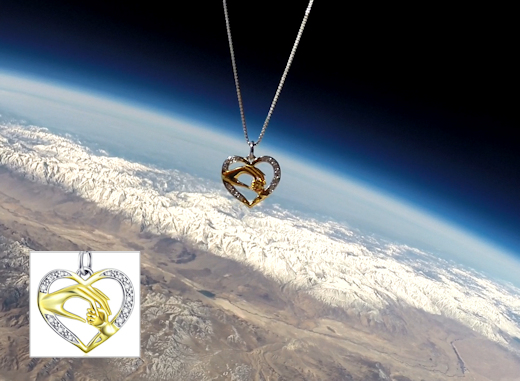
You can have one for $129.95. They make great Mother's Day gifts. The students are selling these pendants as a fund-raiser for their cosmic ray monitoring program. All proceeds support atmospheric radiation measurements and hands-on STEM education.
Each pendant comes with a greeting card showing the jewelry in flight and telling the story of its journey to the stratosphere and back again.
Far Out Gifts: Earth to Sky Store
All sales support hands-on STEM education
Realtime Space Weather Photo Gallery