SPACE WEATHER PROBES SHATTER GPS RECORD: We all use GPS--to find ourselves in the back country, to navigate to the grocery store, to locate lost pets. NASA's four MMS spacecraft recently used the same system to locate themselves an astonishing 116,300 miles from Earth, almost halfway to the Moon. This shatters previous records and expectations of how far away GPS can work. Get the full story.
ROCKETS DUMP CHEMICALS INTO NORTHERN LIGHTS: Last night (April 5th) in Norway, researchers at the Andøya Space Center launched two sounding rockets into a minor geomagnetic storm. The results were out of this world. Aurora tour guide Kim Hartviksen photographed glowing blobs of blue and purple caused by the rockets dumping chemical powders into the storm:

Photo credit: Kim Hartviksen of Aurora Addicts
"Residents for hundreds of miles were taken by surprise by these strange lights, which prompted calls to the police and 'The aliens are coming!' hysteria!" says Chris Nation who runs the Aurora Addicts guiding service.
When the night began, Nation, Hartviksen, and their clients were treated to a display of auroras, ignited by a stream of solar wind buffeting Earth's magnetic field. "As the auroras started to ebb away, our friends at Andøya launched their rockets into the fading lights," says Nation. "The show began anew as the rockets released their payload into the upper atmosphere."
An automated webcam operated by Chad Blakely of Lights over Lapland in Abisko, Sweden, caught the first puffs of powder emerging from the rockets. "It looked like an invasion of UFOs," says Blakley.
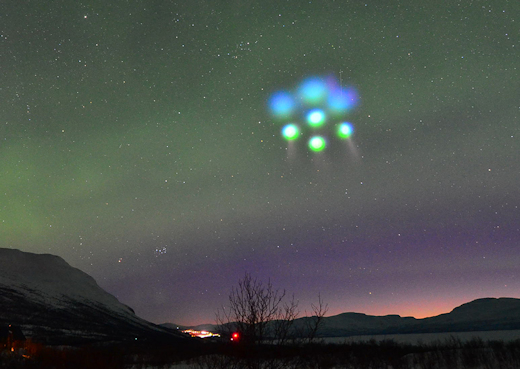
"Soon the glowing blobs evolved into more complicated structures--like two giant squid dancing in the northern sky with an impressive aurora display as its backdrop," decribes Blakley. "Our webcam has been taking a picture every five minutes for nearly 10 years. These images are by far the most exciting I've ever seen it record."
The name of the sounding rocket mission is AZURE--short for Auroral Zone Upwelling Rocket Experiment. Its goal is to measure winds and currents in the ionosphere, a electrically-charged layer of the Earth's atmosphere where auroras appear. Specifically, the researchers are interested in discovering how auroral energy might percolate down toward Earth to influence the lower atmosphere.
The twin rockets deployed two chemical tracers: trimethyl aluminum (TMA) and a barium/strontium mixture. These mixtures create colorful clouds that allow researchers to visually track the flow of neutral and charged particles, respectively. According to NASA, which funded the mission, the chemicals pose no hazard to residents in the region. Aurora alerts: SMS text, email.
Update--a movie! "Here is my realtime video of the surprise rocket launch last night from NASA/ASC," reports Ole Salomonsen of Tromsø, Norway. "I was shocked when I saw this in the night sky facing north, I was not aware of the launch.
A MOTHER'S DAY GIFT FROM THE EDGE OF SPACE: It's sterling silver and it comes from space. On March 22nd, the students of Earth to Sky Calculus flew a cosmic ray balloon to the stratosphere, more than 119,400 feet above Earth's surface. This "Eternal Love" Mother's Day pendant went along for the ride:

You can have one for $129.95. The students are selling these pendants as a fund-raiser for their cosmic ray monitoring program. The pendant is made of sterling silver and the mother holding her baby inside the heart is plated in gold.
Each pendant comes with a greeting card showing the jewelry in flight and telling the story of its journey to the stratosphere and back again.
Far Out Gifts: Earth to Sky Store
All sales support hands-on STEM education
Realtime Space Weather Photo Gallery