PRIVATE MOON LANDING TOMORROW: When humans return to the Moon, it might not be NASA sending them. While America's next Moon rocket is billions of dollars over budget and years behind schedule, a small Israeli company is poised to touchdown on the Moon tomorrow. Their robot named "Beresheet" is scheduled to land on Mare Serenitatis (the Sea of Serenity) on April 11th around 3 pm Eastern time. The event will be livestreamed by SpaceIL, the first private company to land on lunar soil. Robots now, humans next? Stay tuned.
UNDER THE AURORAL OVAL: There are certain places in the world, special places, where auroras appear even without geomagnetic storms. Tromsø, Norway, is one of them. Ole Salomonsen was there last night when the sky filled with swirls of green--no geomagnetic storm required.

"Auroras were dancing over Tromsø almost immediately after the sun set," says Salomonsen. "In theory, it is strange to see such strong and vivid auroras when magnetograms are as silent as they are. This is the good thing about being located just below the auroral oval."
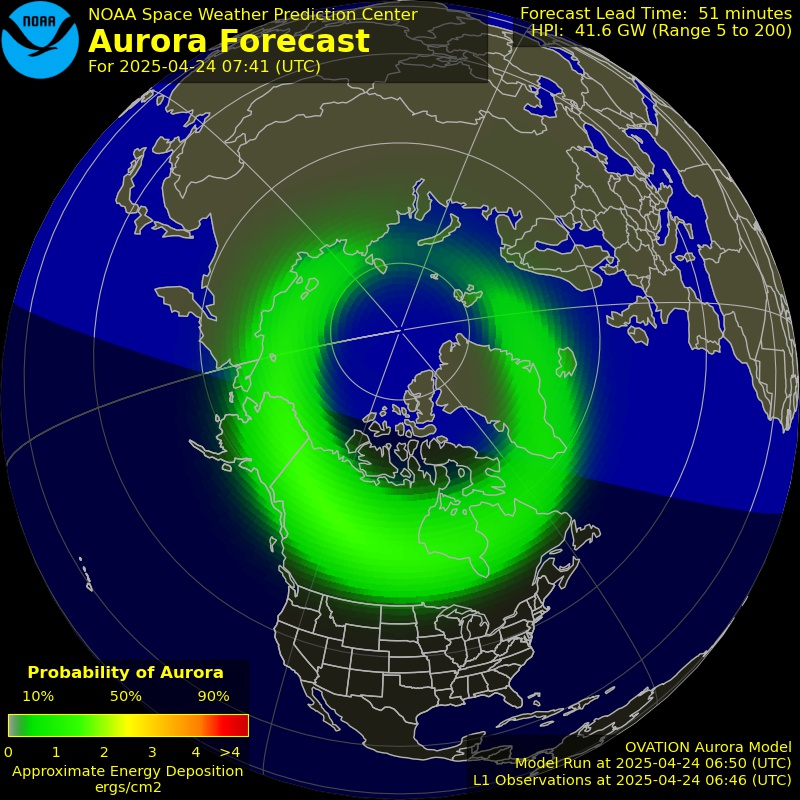
The auroral oval is a donut of light around the North Pole which never goes completely dark because it is excited by a stream of energetic particles raining down from space. The particles are guided there by the shape of our planet's magnetic field. Under the auroral oval, auroras wax and wane, but they never vanish for long even when geomagnetic activity is low.
Except, of course, during summer. "April is here and now we have only a few hours of darkness each night--a window that is narrowing as summer approaches," says Salomonsen. "In Tromsø, this week may be the last of the season with visible auroras." Aurora alerts: SMS text, email.
PUERTO RICAN FIREBALL: What are the odds? On April 9th at 04:01 Atlantic Time, a random meteoroid hit Earth's atmosphere and disintegrated with the luminosity of a waxing crescent Moon. The impact, which could've happened anywhere, took place directly above a video camera in Cabo Rojo, Puerto Rico:

"This fireball streaked over the Caribbean Sea south of Cabo Rojo," says Frankie Lucena, who operates the camera. "Also seen is the Lajas Aerostat (a tethered radar balloon) and Alpha Centauri."
Lucena estimates the magnitude of the fireball as approximately -11. Using a computer model of Earth's meteoroid environment, Bill Cooke of the Marshall Space Flight Center calculates that fireballs this bright come along once every 20 days or so. Rarely, however, are they witnessed. About 70% of all fireballs streak over uninhabited ocean while half appear during the day, invisible in sunny skies. To catch one in the crosshairs of a meteor camera on a dark night is good luck indeed.
Realtime Space Weather Photo Gallery
A MOTHER'S DAY GIFT FROM THE EDGE OF SPACE: Mother's Day is barely a month away. Nothing says "I love you" like a rose quartz heart from the edge of space. On Jan. 26, 2019, the students of Earth to Sky Calculus flew this pendant 101,908 feet above the snow-capped Sierras of central California:

You can have it for $119.95. The students are selling the pendants to support their cosmic ray ballooning program. Each one comes with a greeting card showing the rose-colored heart in flight and telling the story of its journey to the edge of space. All sales support Earth to Sky Calculus cosmic ray measurements and hands-on STEM research.
Far Out Gifts: Earth to Sky Store
All sales support hands-on STEM education
Realtime Space Weather Photo Gallery