THE FIRST PRIVATE LUNAR LANDER CRASHES: Landing would have been nice, but even crashing on the Moon is an impressive accomplishment for a private company. That's what happened on April 11th when Israel's Beresheet lunar lander plunged into Mare Serenitatis following a main engine malfunction. "Well, we didn't make it, but we definitely tried," said Morris Kahn, chairman of SpaceIL, the first private company to attempt a lunar landing. Next time!
EXPERTS PREDICT A LONG, DEEP SOLAR MINIMUM: If you like solar minimum, good news: It could last for years. That was one of the predictions issued last week by an international panel of experts who gathered at NOAA's annual Space Weather Workshop to forecast the next solar cycle. If the panel is correct, already-low sunspot counts will reach a nadir sometime between July 2019 and Sept 2020, followed by a slow recovery toward a new Solar Maximum in 2023-2026.
"We expect Solar Cycle 25 will be very similar to Cycle 24: another fairly weak maximum, preceded by a long, deep minimum," says panel co-chair Lisa Upton, a solar physicist with Space Systems Research Corp.

The solar cycle is like a pendulum, swinging back and forth between periods of high and low sunspot number every 11 years or so. Researchers have been tracking the cycle since it was discovered in the 19th century. Not all cycles are alike. Some are intense, with lots of sunspots and explosive solar flares; the Space Age began with a big booming solar maximum. Others are weak, such as the most recent, Solar Cycle 24, which peaked in 2012-2014 with relatively little action.
Researchers are still learning to predict the ebb and flow of solar activity. Forecasting techniques range from physical models of the sun's inner magnetic dynamo to statistical methods akin to those used by stock market analysts.
"We assessed ~61 predictions in the following categories: Climatology, Dynamo, Machine Learning/Neural Networks, Precursor Methods, Spectral/Statistical Methods, Surface Flux Transport, and Other," says Upton. "The majority agreed that Solar Cycle 25 would be very similar to Solar Cycle 24."
"Here," she says, "is a figure showing the last minimum and where we are with the current minimum."

"As you can see – we haven't quite reached the lowest levels of the last cycle – where we experienced several consecutive months with no sunspots. However, the panel expects that we should reach those levels [between now and the end of 2020]."
In recent years, the Internet has buzzed with the idea that a super-deep solar minimum such as the 70-year Maunder Minimum of the 17th century might cool the Earth, saving us from climate change. That's not what the panel is saying, however.
"There is no indication that we are currently approaching a Maunder-type minimum in solar activity," says Upton. Solar minimum will be deep, but not that deep.
Story continues after the advertisement...
A MOTHER'S DAY GIFT FROM THE EDGE OF SPACE: It's sterling silver and it comes from space. On March 5th, the students of Earth to Sky Calculus flew a cosmic ray balloon to the stratosphere, more than 94,000 feet above Earth's surface. This "Loving Hands" pendant went along for the ride:
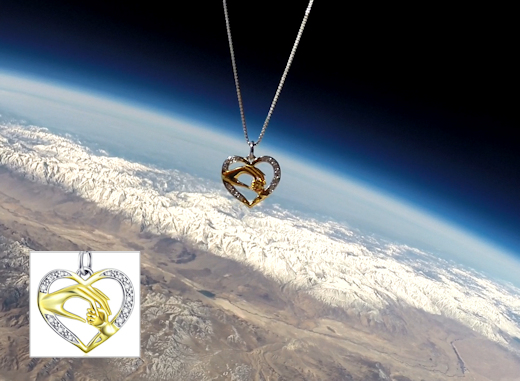
You can have one for $129.95. The students are selling these pendants as a fund-raiser for their cosmic ray monitoring program. All proceeds support atmospheric radiation measurements and hands-on STEM education.
Each pendant comes with a greeting card showing the jewelry in flight and telling the story of its journey to the stratosphere and back again.
Far Out Gifts: Earth to Sky Store
All sales support hands-on STEM education
SOLAR MINIMUM, CONTINUED: The panel predicts a "fairly weak" Solar Cycle 25. What does that mean? Saying that a solar cycle is "weak" is a bit like saying hurricane season will be "weak." In other words, there may be fewer storms, but when a storm comes, you'd better batten down the hatches. "Weak" Solar Cycle 24 produced a number of intense X-class solar flares, strong geomagnetic storms, and even a Ground Level Event (GLE) when solar energetic particles reached Earth's surface. An equally "weak" Solar Cycle 25 could do the same 3 or 4 years hence.

Meanwhile, we have solar minimum. This is a widely misunderstood phase of the solar cycle. Many people think it brings a period of dull quiet. In fact, space weather changes in interesting ways. As the sun's magnetic field weakens, holes open in the sun's atmosphere. Emerging streams of solar wind buffet Earth's magnetic field, sustaining auroras even without solar flares and sunspots. Some observers believe that Solar Minimum auroras have a distinctive palette, pinker than during other phases of the solar cycle.
The sun's weakening magnetic field also allows cosmic rays to enter the solar system. Energetic particles from deep space penetrate Earth's atmosphere with a myriad of possible effects ranging from changes in upper atmospheric electricity to extra doses of radiation for people on airplanes.
Finally, the sun dims, especially at extreme ultraviolet wavelengths. This, in turn, causes the upper atmosphere to cool and contract. Aerodynamic drag that would normally cause satellites to decay is reduced; space junk accumulates. This effect makes solar minimum a terrible time to blow up satellites–although people do it anyway.
The Solar Cycle Prediction Panel is comprised of scientists representing NOAA, NASA, the International Space Environment Services, and other U.S. and international scientists. Their April 5th prediction was preliminary, and they plan to issue a refined forecast by the end of 2019.
A sharable version of this story is available here. Aurora alerts: SMS text, email.
Realtime Space Weather Photo Gallery