EXPERTS PREDICT A LONG, DEEP SOLAR MINIMUM: An international panel of researchers led by NASA and NOAA has released a new prediction for the solar cycle: The current solar minimum is going to deepen, potentially reaching a century-class low in the next year or so. This will be followed by a new Solar Max in the years 2023-2026. Get the full story here.
BIG SUNSPOT FACES EARTH: This weekend, one of the biggest sunspots since the solar storms of Sept. 2017 is directly facing Earth. AR2738 has a primary core three times wider than our planet and it is creating a wake of magnetic froth on the sun's surface more than 200,000 km long:
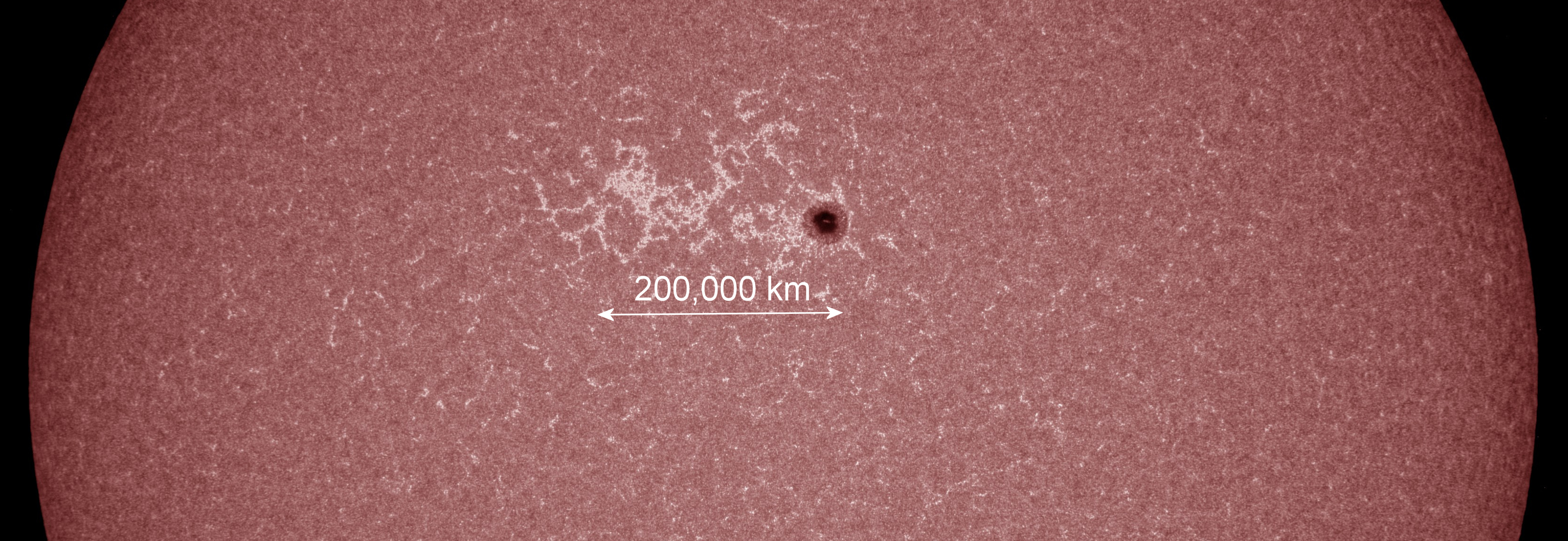
Above: An extreme ultraviolet image from NASA's Solar Dynamics Observatory
Since it first appeared one week ago, the behemoth spot has not produced any very strong solar flares. However, something interesting is happening to AR2738. It may be splitting apart.
The primary core of sunspot AR2738 is divided by a growing canyon of light--also known as a "light bridge"--measuring 20,000 km from end to end. Yesterday, amateur astronomer Martin R. Wise photographed the phenomenon from his backyard observatory in Trenton, Florida. Follow the arrow:
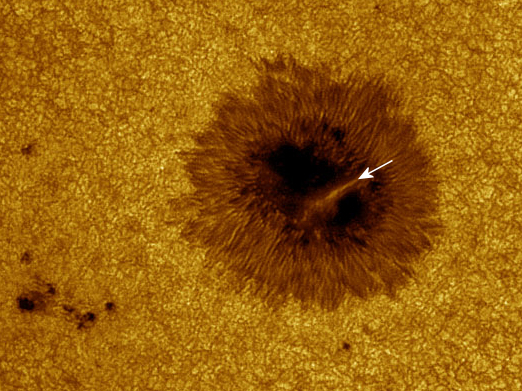
Wise's photo is remarkably detailed. The light bridge is only about 800 km wide--less than the width of Texas. His image captures not only that narrow divide, but also hundreds of Texas-sized granules on the sun's boiling surface around the sunspot.
The nature of light bridges is not fully understood. They often herald the break-up of a sunspot, with jets of plasma shooting up from the chasm as the sunspot decays. Some research suggests that magnetic fields at the base of a light bridge are busy cross-crossing and reconnecting--the same explosive process that sparks solar flares. Does this mean sunspot AR2738 will explode--or quietly fall apart? No one can say. Readers with solar telescopes are encouraged to monitor developments.
More photos: The light bridge is also visible in images from Andy Devey in southern Spain; from Francois Rouviere of Cannes, France; from Shahrin Ahmad of Kuala Lumpur, Malaysia; from Howard Eskildsen of Ocala, Florida.
Realtime Space Weather Photo Gallery
A GIFT FROM THE EDGE OF SPACE: Looking for an over-the-Moon gift? Consider this: On Jan. 4th, the students of Earth to Sky Calculus flew this 3D printed Moon globe to the stratosphere, 36.3 km (119,095 ft) above California's Sierra Nevada mountains:
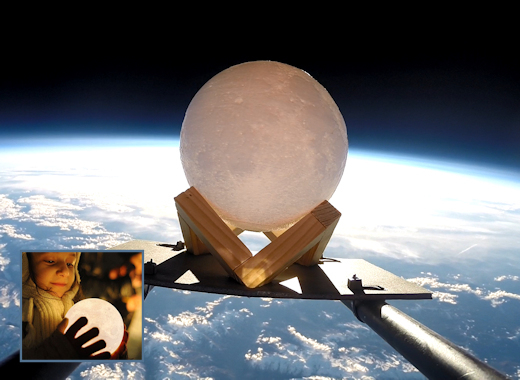
You can have it for $149.95. The students are selling these globes to support their cosmic ray ballooning program.
The surface of the sphere is an accurate topo-map of lunar terrain, tracing every major crater and mountain range. It is also a night light. A built-in USB-rechargeable battery provides up to 20 hours of romantic illumination. Each glowing orb comes with a greeting card showing the Moon in flight and telling the story of its journey to the edge of space.
Far Out Gifts: Earth to Sky Store
All sales support hands-on STEM education
LIGHT PILLARS OVERHEAD: Many of us have witnessed light pillars--columns of light reflected from ice crystals in the air. On cold days in northern cities, they form tall luminous towers over bright urban lights. But how many of us have seen light pillars directly overhead? Filipe Alves did yesterday in Lisbon, Portugal:
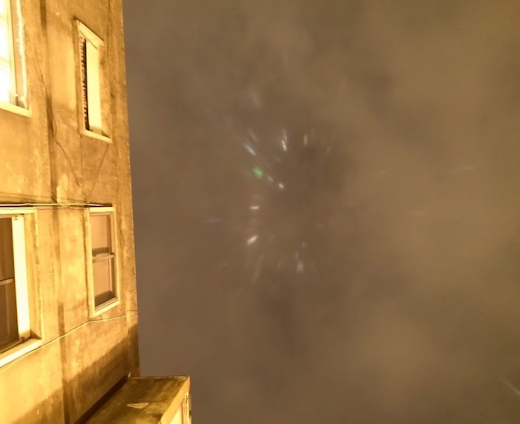
"As I was walking the streets of Lisbon, I looked up and saw several streaks of light, some white and a strong green streak, almost looked like an aurora borealis," says Alves. "I suspect it was a reflection of city lights on ice crystals in the clouds above. The position of the streaks seemed to track the city's main arteries."
"I have seen light pillars before, but this is the first time I've seen them almost directly overhead," he says. "It was amazing."
Realtime Space Weather Photo Gallery