EXPERTS PREDICT A LONG, DEEP SOLAR MINIMUM: An international panel of researchers led by NASA and NOAA has released a new prediction for the solar cycle: The current solar minimum is going to deepen, potentially reaching a century-class low in the next year or so. This will be followed by a new Solar Max in the years 2023-2026. Get the full story here.
BIG SUNSPOT PRODUCES "OCEAN SURF" SOUNDS: If you have a shortwave radio, you might have heard some unusual sounds this week. Big sunspot AR2738 is producing strong bursts of radio static. "They sound like ocean surf," says Thomas Ashcraft, who recorded this specimen on April 13th using an amateur radio telescope in New Mexico:
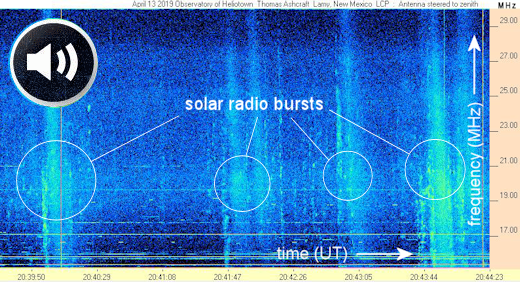
These radio sounds are caused by beams of electrons--in this case, accelerated by B-class explosions in the sunspot's magnetic canopy. As the electrons slice through the sun's atmosphere, they generate a ripple of plasma waves and radio emissions detectable on Earth 93 million miles away. Astronomers classify solar radio bursts into five types; Ashcraft's recording captured a Type III.
"There have been a lot of these sounds over the past week, and they appear to be intensifying now that the sunspot is directly facing Earth," says Ashcraft.
Readers, if you would like to detect solar radio bursts in your own backyard, order a radio telescope kit from NASA's RadioJOVE project.
Realtime Space Weather Photo Gallery
MOTHER'S DAY IS LESS THAN ONE MONTH AWAY: Tell Mom how much you love her -- to the Moon and Back! On March 5th, the students of Earth to Sky Calculus launched an array of cosmic ray sensors to the edge of space onboard a helium balloon. This Mother's Day pendant went along for the ride:

The silvery crescent declares "I love you to the Moon and Back" and surrounds a 14K gold plated heart labeled "Mom."
You can have it for $99.95. The students are selling these pendants to support their cosmic ray ballooning program. Each one comes with a greeting card showing the item in flight and telling the story of its journey to the edge of space. Sales support the Earth to Sky Calculus cosmic ray ballooning program and hands-on STEM research.
Far Out Gifts: Earth to Sky Store
All sales support hands-on STEM education
FALCON HEAVY MAKES A "ROCKET COMET": On April 11th at 6:35 pm EDT, SpaceX launched the new Arabsat-6A communications satellite onboard a Falcon Heavy rocket. Later the same evening, Petr Horálek looked up at the Milky Way from Soneva Fushi, an atoll in the Maldive Islands south of Africa. "I got a big surprise," says Horálek. "From out of nowhere, a big diffuse slowly moving object appeared in Aquarius, getting wider and wider, and looking like a big comet in the sky."

Horálek witnessed the Falcon Heavy's second stage, executing a burn which propelled the satellite into a geosynchronous orbit. "The image shows an 8 minute long exposure of the phenomenon while the object was expanding in the sky (moved from right to left)," he explains. "I have never seen something like that before, such a unique and spectacular show in the sky!"
This is the same type of rocket that, on its maiden voyage 14 months ago, hurled a cherry red roadster to the orbit of Mars. The Falcon Heavy is currently the world's most powerful rocket and has the third-highest capacity of any rocket ever to reach orbit, trailing only the America's mighty Saturn V and the Soviet Energia. If SpaceX continues its successes with the Falcon Heavy, "rocket comets" could become a frequent sight in the years ahead.
Realtime Space Weather Photo Gallery