EXPERTS PREDICT A LONG, DEEP SOLAR MINIMUM: An international panel of researchers led by NASA and NOAA has released a new prediction for the solar cycle: The current solar minimum is going to deepen, potentially reaching a century-class low in the next year or so. This will be followed by a new Solar Max in the years 2023-2026. Get the full story here. Free: SWx Newsletter.
BIG SUNSPOT PRODUCES "OCEAN SURF" SOUNDS: If you have a shortwave radio, you might have heard some unusual sounds this week. Big sunspot AR2738 is producing strong bursts of radio static. "They sound like ocean surf," says Thomas Ashcraft, who recorded this specimen on April 13th using an amateur radio telescope in New Mexico:
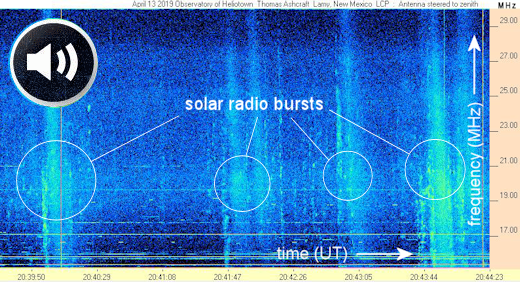
These radio sounds are caused by beams of electrons--in this case, accelerated by B-class explosions in the sunspot's magnetic canopy. As the electrons slice through the sun's atmosphere, they generate a ripple of plasma waves and radio emissions detectable on Earth 93 million miles away. Astronomers classify solar radio bursts into five types; Ashcraft's recording captured a Type III.
"There have been a lot of these sounds over the past week, and they appear to be intensifying now that the sunspot is directly facing Earth," says Ashcraft.
Readers, if you would like to detect solar radio bursts in your own backyard, order a radio telescope kit from NASA's RadioJOVE project.
A sharable version of this story is available here.
Free: Spaceweather.com Newsletter
SUNSPOT SUNRISE: Sunspot AR2738 is is three times wider than Earth and covers more than a billion square kilometers of the sun's surface. It's so big, people are seeing it in the sunrise. "I had a pleasant surprise this morning," reports Trevor Perry of Garrucha, Spain. "The giant sunspot was visible as the sun came up over the sea."

A close look at Perry's photo reveals more than the sunspot. The sun itself is sliced into multiple layers by temperature inversions over the sea surface, giving the solar disk a jagged edge. A zoomed-in image of the sunspot would have undoubtedly revealed similar distortions in its dark outline.

AR2738 is an unusually large sunspot, especially considering the low state of the solar cycle. Photographers around the world are busy taking its picture, with beautiful results. Browse the Realtime Photo Gallery for more.
Warning: Even when the sun is dimmed by low-hanging clouds or haze, it can still damage your eyes. Sunlight magnified by unfiltered optics is dangerously bright. If you chose to photograph the low sun, as Perry did, use the camera's LCD screen for safe viewfinding. Never look into the eyepiece of an unfiltered camera or telescope when the sun is in the field of view.
Realtime Space Weather Photo Gallery
MOTHER'S DAY IS LESS THAN ONE MONTH AWAY: Tell Mom how much you love her -- to the Moon and Back! On March 5th, the students of Earth to Sky Calculus launched an array of cosmic ray sensors to the edge of space onboard a helium balloon. This Mother's Day pendant went along for the ride:

The silvery crescent declares "I love you to the Moon and Back" and surrounds a 14K gold plated heart labeled "Mom."
You can have it for $99.95. The students are selling these pendants to support their cosmic ray ballooning program. Each one comes with a greeting card showing the item in flight and telling the story of its journey to the edge of space. Sales support the Earth to Sky Calculus cosmic ray ballooning program and hands-on STEM research.
Far Out Gifts: Earth to Sky Store
All sales support hands-on STEM education