SOLAR WIND, INCOMING: A southern hole in the sun's atmosphere is facing Earth and spewing a stream of solar wind in our direction. Estimated time of arrival: April 23rd. Minor geomagnetic unrest and polar auroras are possible when the gaseous material arrives. Aurora Alerts: SMS Text.

CORONAL MASS EJECTION: Big sunspot AR2738 is rotating over the sun's western limb today. Just before it vanished for a 2-week trip around the sun's farside, the sunspot unleashed a parting shot: a B8-class solar flare and a coronal mass ejection (CME). The Solar and Heliospheric Observatory recorded the CME as it shot out into space:

This CME will not hit Earth. Nevertheless, the explosion was mildly geoeffective. Energetic electrons accelerated by the blast followed the sun's curved magnetic field back toward Earth, causing a slight enhancement of the radiation environment around our planet--already subsiding. See you again in two weeks, AR2738!

POLLEN CORONAS: It begins with a sneeze. Pollen floating through the air tickles your nose, and your body responds by expelling the allergen. Gesundheit!
That's German for "look at the sun." Not really, but look anyway. The same pollen that makes you sneeze can also make beautiful coronas around the sun, like this one photographed on April18th by Ujvárosi Beáta of Szerencs, Hungary:

"We had warm, sunny weather with strong winds today," says Beáta. "These conditions are perfect for tiny pollen grains to be lifted and carried in the air."
Specks of pollen are very small, and when they float through the air they diffract sunlight, forming the softly-colored rings of light in Beáta's photo. Tiny crystals of ice or droplets of water in the air can do much the same thing--but unlike pollen they do not cause sternutation.
Free: Spaceweather.com Newsletter
MOTHER'S DAY IS LESS THAN ONE MONTH AWAY: Nothing says "I Love You" like a heart-shaped pendant from the edge of space. On Dec. 31st, the students of Earth to Sky Calculus flew an array of cosmic ray sensors to the stratosphere onboard a giant helium balloon. This pendant went along for the ride:
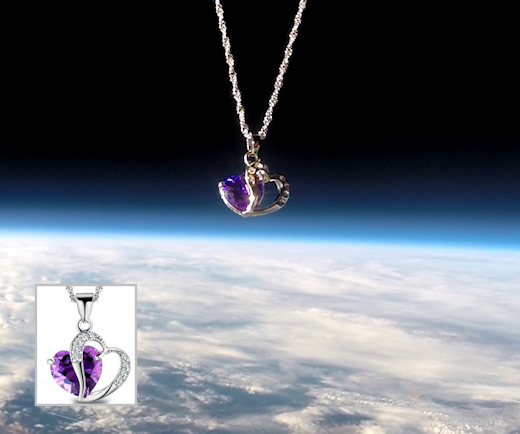
You can have it for $129.95. The students are selling these pendants as a fund-raiser for their cosmic ray monitoring program--and they make great Mother's Day gifts. All proceeds support atmospheric radiation measurements and hands-on STEM education.
Each pendant comes with a greeting card showing the jewelry in flight and telling the story of its journey to the stratosphere and back again. Mom-satisfaction guaranteed.
Far Out Gifts: Earth to Sky Store
All sales support hands-on STEM education
Realtime Space Weather Photo Gallery
Realtime Aurora Photo Gallery