SUBSIDING STORM: A minor G1-class geomagnetic storm is subsiding now. The storm began around UT midnight on May 10-11 as Earth was moving into the wake of a CME that hit only hours earlier. During the storm's peak, auroras were sighted in multiple northern-tier US states and Canada. Aurora Alerts: SMS Text.

RARE BLUE AURORAS OVER CANADA: Northern Lights are usually green, sometimes red. Those are the colors we see when oxygen is hit by electrons raining down from space during a geomagnetic storm. Last night, however, Harlan Thomas of Calgary, Alberta, witnessed a different color: deep-blue.
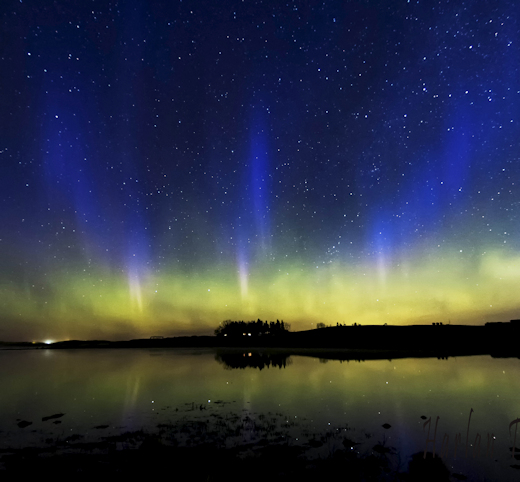
"To see these incredible blue pillars was out of this world," says Thomas.
In auroras, blue is a sign of nitrogen. Energetic particles striking ionized molecular nitrogen (N2+) at very high altitudes can produce a blue glow rarely seen during auroral displays. In this case, it was the afterglow of a CME impact.
The CME left the sun on May 6th, propelled in our direction by an explosion in the magnetic canopy of sunspot AR2740. When it finally arrived on May 10th, the slow-moving storm cloud rattled Earth's magnetic field, triggering a minor G1-class geomagnetic storm. Auroras were sighted in parts of Canada as well as US States such as Michigan and Minnesota.
"To top it off, STEVE appeared for several minutes as well," says Thomas, who captured it in this shot:
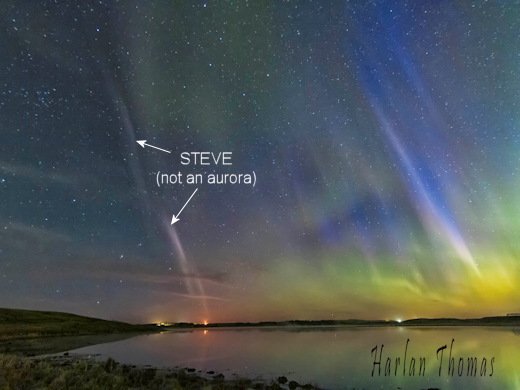
STEVE is a hot (3000 degrees C) ribbon of ionized gas slicing through Earth's upper atmosphere some 300 km above the ground. It appears unpredictably during some, but not all, geomagnetic storms. Originally thought to be a form of aurora borealis, new research shows that it is not an aurora at all.
The soft purple color of STEVE may also be caused by emissions from nitrogen, according to a new study just published in the Geophysical Research Letters. Coincidence? STEVE and blue auroras seem to share a connection to the 7th element on the periodic table.
Blue auroras are most often seen during intense geomagnetic storms--yet this was a relatively minor storm. Why nitrogen-blue overtopped the usual hues of oxygen on May 11th is unclear. It just goes to show, auroras still have the capacity to surprise. Aurora Alerts: SMS Text.
CRYSTAL MOON BALL IN THE STRATOSPHERE: On Star Wars Day ("May the 4th be with you"), the students of Earth to Sky Calculus launched an array of cosmic ray sensors to the stratosphere. They do this every week or so to monitor increasing levels of atmospheric radiation. This crystal Moon ball went along for the ride:
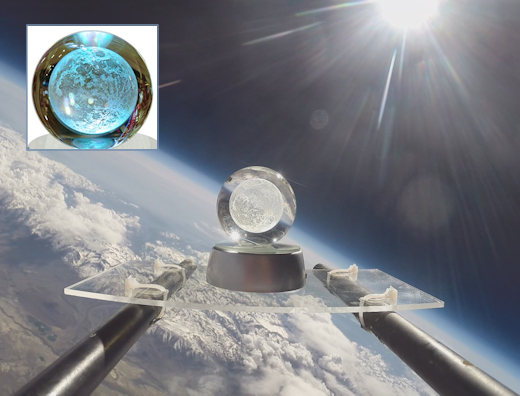
You can have it for $129.95. The students are selling these far-out balls to support their cosmic ray ballooning program.
Each one comes with an LED base that turns the laser-etched crystaline Moon a beautiful shade of purple, blue, green or yellow. It makes a great night light. Also included is a greeting card showing the crystal ball in flight and telling the story of its journey to the edge of space and back again.
Far Out Gifts: Earth to Sky Store
All sales support hands-on STEM education