RARE BLUE AURORAS OVER CANADA: Auroras are usually green. Not this weekend, however. On May 10th a CME hit Earth's magnetic field, sparking a display of deep-blue auroras over Canada. Read the full story to learn the special ingredient that turns auroras blue. Aurora Alerts: SMS Text.
GEOMAGNETIC STORM PREDICTED: Three and possibly four CMEs are en route to Earth following a series of explosions near sunspot AR2741. The most potent so far occurred on May 12th when a filament of magnetism surrounding the sunspot became unstable and erupted. The blast zone was more than 220,000 km in diameter:

Similar eruptions on May 10th, 11th and 13th combined with this one to produce a train of faint coronal mass ejections (CMEs) heading in our direction. The incoming CMEs are lightweights compared to the bright massive CMEs typically seen during Solar Maximum. However, their combined effect could rattle Earth's magnetic field.
NOAA forecasters estimate a 55% to 60% chance of G1-class geomagnetic storms on May 15th and 16th. Isolated periods of even stronger G2-class storms are possible as well. Aurora Alerts: SMS Text.


SPRITE STORM OVER EUROPE: On Saturday night in the Czech republic, Martin Popek photographed dozens of red sprites leaping up from a thunderstorm 280 km away. "They were over the intersectng borders of Austria, Hungary and Slovakia," he says.

Unlike ordinary lightning bolts, which lance down from thunderstorms, sprites fly up. They spread their gossamer red structures through the upper atmosphere alongside auroras and noctilucent clouds, making them a true space weather phenomenon.
Some researchers believe sprites are linked to cosmic rays: subatomic particles from deep space strike the top of Earth's atmosphere, producing secondary electrons that may spark the eerie red forms. If this link is real, it could mean more sprites are in the offing. Cosmic rays are increasing to their greatest intensity in more than 50 years. Here's how to look.
CRYSTAL MOON BALL IN THE STRATOSPHERE: On Star Wars Day ("May the 4th be with you"), the students of Earth to Sky Calculus launched an array of cosmic ray sensors to the stratosphere. They do this every week or so to monitor increasing levels of atmospheric radiation. This crystal Moon ball went along for the ride:
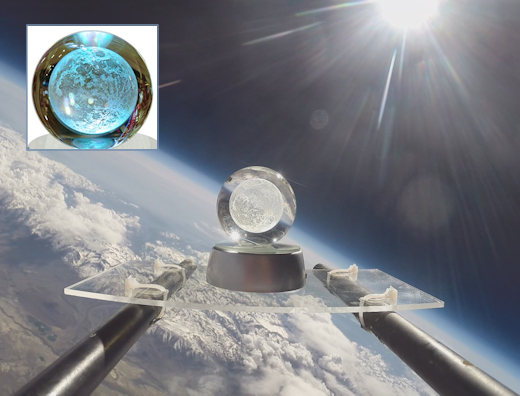
You can have it for $129.95. The students are selling these far-out balls to support their cosmic ray ballooning program.
Each one comes with an LED base that turns the laser-etched crystaline Moon a beautiful shade of purple, blue, green or yellow. It makes a great night light. Also included is a greeting card showing the crystal ball in flight and telling the story of its journey to the edge of space and back again.
Far Out Gifts: Earth to Sky Store
All sales support hands-on STEM education