GEOMAGNETIC STORMS PREDICTED THIS WEEK: NOAA forecasters say there is a 55% to 60% chance of geomagnetic storms on May 15th and 16th when a series of coronal mass ejections (CMEs) could hit Earth's magnetic field. Storm levels are expected to range between category G1 and G2. This means auroras could be sighted in northern-tier US states such as Montana, Minnesota, and upstate New York. Aurora Alerts: SMS Text.


SURPRISE STORM SPARKS AURORAS IN THE USA: A surprise geomagnetic storm erupted during the early hours of May 14th when a crack opened in Earth's magnetic field. Solar wind poured through the gap, igniting auroras over northern-tier US states. Paul Nelson photographed the display from the shore of Lake Superior near Marquette, Michigan:

"The auroras were bright enough to see reflected in the still waters of Lake Superior," says Nelson. "The ISS made a visible pass during the best part of the show, right across and above the Northern Lights."
Auroras were also sighted in Ohio, the Dakotas, and Wyoming.
At its peak, the storm reached category G3--one of the strongest in years. The storm is now subsiding, but more storms are likely this week in response to a series of approaching CMEs. Aurora Alerts: SMS Text.


COSMIC RAY BALLOON: When CMEs are coming, there's only one thing to do: Launch a cosmic ray balloon. Spaceweather.com and the students of Earth to Sky Calculus launched this one on May 13th:

The balloon carried an array of X-ray/gamma-ray sensors to the stratosphere more than 100,000 feet above Earth's surface. The students have been launching these balloons almost once a week for the past 4 years. They find that cosmic rays are increasing--a trend that might temporarily reverse this week.
CMEs sweep aside cosmic rays, causing atmospheric radiation levels to drop. The phenomenon is called a "Forbush Decrease," named after physicist Scott E. Forbush who first described it. The May 13th launch established a baseline by measuring levels before the CMEs arrived. During- and after-CME launches will take place in the days ahead. Stay tuned for results.
CRYSTAL MOON BALL IN THE STRATOSPHERE: On Star Wars Day ("May the 4th be with you"), the students of Earth to Sky Calculus launched an array of cosmic ray sensors to the stratosphere. They do this every week or so to monitor increasing levels of atmospheric radiation. This crystal Moon ball went along for the ride:
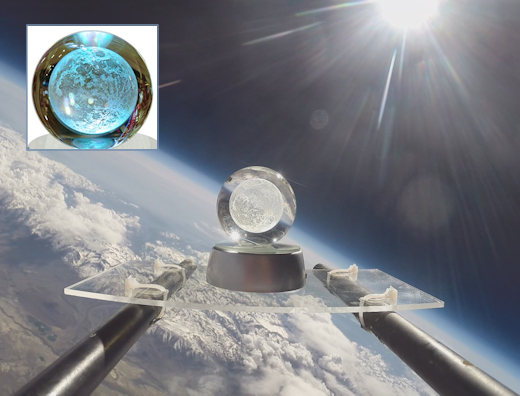
You can have it for $129.95. The students are selling these far-out balls to support their cosmic ray ballooning program.
Each one comes with an LED base that turns the laser-etched crystaline Moon a beautiful shade of purple, blue, green or yellow. It makes a great night light. Also included is a greeting card showing the crystal ball in flight and telling the story of its journey to the edge of space and back again.
Far Out Gifts: Earth to Sky Store
All sales support hands-on STEM education