WAITING FOR THE SOLAR STORM: NOAA forecasters say there is a 75% chance of geomagnetic storms on May 16th when a CME is expected to hit Earth's magnetic field. The impact could cause storms ranging in strength from category G1 (minor) to G2 (moderate) with auroras in northern-tier US states such as Maine, Minnesota, the Dakotas, Montana and Washington State. Aurora Alerts: SMS Text.


THE REMAINS OF OLD SUNSPOT AR2740: Around the world, today, amateur astronomers are reporting tall plumes of gas rising over the sun's northwestern limb. The source of the activity appears to be old sunspot AR2740. Here is the view from NASA's Solar Dynamics Observatory:

The prominence rises almost 50,000 km above the edge of the sun. That means it is 4 times as tall as Earth. These dimensions make it an easy target for backyard solar telescopes. Astronomers are encouraged to monitor the area for developments. While sunspot AR2740 is about to disappear, an even bigger sunspot AR2741 is approaching the same spot for an even more flamboyant display.
Free: Spaceweather.com Newsletter
THE GOLDEN HANDLE: The Moon will be full in just under 4 days. That means it's time to look for the "Golden Handle." Peter Lowenstein caught it on Wednesday morning, May 15th, as the Moon was setting over Mutare, Zimbabwe:

"The waxing gibbous Moon was sinking behind the summit of Murahwa Mountain when I took this picture," says Lowenstein. "I could clearly see the Golden Handle."
The Golden Handle appears once a month when the sun rises over the Moon's Bay of Rainbows (Sinus Iridum). Sunbeams cutting almost horizontally across the bay's hardened lava plains clip the top of the surrounding Jura Mountains (Montes Jura) forming a golden-crested "handle."
Did you miss the handle? It'll be back next month before the full Moon of June. On your calendar circle June 12th and label it "Golden Handle."
Realtime Space Weather Photo Gallery
CRYSTAL MOON BALL IN THE STRATOSPHERE: On Star Wars Day ("May the 4th be with you"), the students of Earth to Sky Calculus launched an array of cosmic ray sensors to the stratosphere. They do this every week or so to monitor increasing levels of atmospheric radiation. This crystal Moon ball went along for the ride:
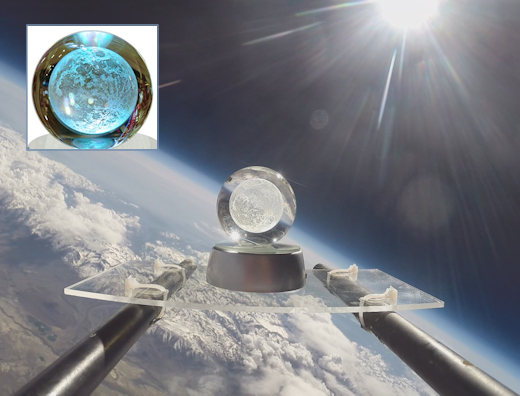
You can have it for $129.95. The students are selling these far-out balls to support their cosmic ray ballooning program.
Each one comes with an LED base that turns the laser-etched crystaline Moon a beautiful shade of purple, blue, green or yellow. It makes a great night light. Also included is a greeting card showing the crystal ball in flight and telling the story of its journey to the edge of space and back again.
Far Out Gifts: Earth to Sky Store
All sales support hands-on STEM education