STORM CANCELLED: It's official. The CMEs missed. A series of coronal mass ejections expected to hit Earth's magnetic field between May 15th and May 17th did not hit--at least, not directly. When NOAA forecasters said there was a 75% chance of storms, that also meant a 25% chance of no storms. This time the 25% won. Aurora Alerts: SMS Text.
GOODBYE SUNSPOT AR2741: If you have a backyard solar telescope, point it at the sun's western limb. Active sunspot AR2741 is there, and it's putting on a good show:

While AR2741 is near the edge of the solar disk, we can see its magnetic canopy sticking out into space. Arcing lines of magnetic force hold glowing-hot plasma aloft. The velvety darkness of space makes a great canvas for the display.
This weekend. AR2741 will disappear as it begins a 2-week trip around the farside of the sun. Will it survive the transit? Probably not. The sunspot is in a state of decay and will likely disintegrate in the weeks ahead. Goodbye AR2741, and thanks for all the CMEs.
Realtime Space Weather Photo Gallery
3D-PRINTED GLOWING MOON GLOBE: Are you looking for an over-the-Moon gift? Consider this: Last month, the students of Earth to Sky Calculus flew this 3D printed Moon globe to the stratosphere, 36.3 km (119,095 ft) above California's Sierra Nevada mountains:
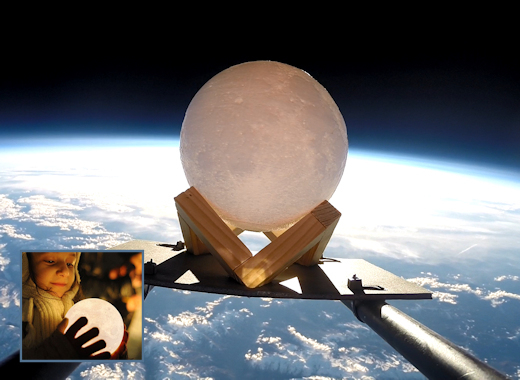
You can have it for $149.95. The students are selling these globes to support their cosmic ray ballooning program. Each glowing orb comes with a greeting card showing the Moon in flight and telling the story of its journey to the edge of space.
The surface of the sphere is an accurate topo-map of lunar terrain, tracing every major crater and mountain range. It is also a night light. A built-in USB-rechargeable battery provides up to 20 hours of romantic illumination.
Far Out Gifts: Earth to Sky Store
All sales support hands-on STEM education
AN "X" IN THE SKY: Last week, Marcella Giulia Pace of Livinallongo Col di Lana, Italy, looked at the bright sun, then turned away, squinting. To her surprise, she saw a luminous X in the sky. Blinking didn't make it go away. "It was a rare Wegener Arc," she says.

In the picture, above, the faint X-shaped Wegener Arc is bisected by a bright parhelic circle. They intersect just above the tip of the tree at a point in the sky directly opposite the sun.
Wegener Arcs are caused by sunbeams passing through pencil-shaped ice crystals in the clouds. For the arc to form, the sunbeam must enter through one face of the crystal, bounce off the inside, then exit through another face tilted 60 degrees with respect to the first. No wonder they're rare.

Above: The formation of the Wegener Arc. [more]
The bright parhelic circle is formed in a different way when sunlight shines through plate-shaped crystals. It is rare, too, but not as rare as the Wegener Arc. All in all, a lucky catch. "It made my day," says Pace.