ALERT! THE GREAT RED SPOT IS DISTORTED: Astrophotographer Anthony Wesley of Rubyvale, Australia, has just observed Jupiter's Great Red Spot (GRS) and he reports that the giant storm is "badly distorted." This follows multiple observations by amateur astronomers of streamers of gas peeling off the GRS. "It seems the process taking place there is increasing significantly in intensity," says Wesley. Here are his latest filtered images: blue; infrared; RGB.
POLAR MESOSPHERIC SUMMER ECHOES: Every summer since the late 1970s, radars probing Earth's upper atmosphere have detected strong echoes from altitudes between 80 km and 90 km. What's up there? Noctilucent clouds (NLCs). NASA's AIM spacecraft is still waiting to spot the first NLCs of the 2019 season, but the echoes have already begun. Rob Stammes of the Polarlightcenter in Lofoten, Norway, detected them on May 19th and 20th:

"I detected these VHF signals coming from transmitters in Eastern Europe," he explains. "Before they reached my receiver in Norway, they bounced off something in the mesosphere. The echoes were recognizable and very strong."
Researchers call them "Polar Mesospheric Summer Echoes" or "PMSEs." They occur over the Arctic during the months of May through August, and over the Antarctic during the months of November through February. These are the same months that NLCs appear.
The underlying physics of these echoes is still uncertain. A leading theory holds that the ice particles in noctilucent clouds are electrically charged, and this makes them good reflectors of radio waves. However, NLCs are not always visible when the radar echoes are observed and vice versa.

Above: Noctilucent clouds observed by Kairo Kiitsak of Simuna, Estonia, on July 26, 2018.
The echoes Stammes detected suggest that the season for NLCs is about to begin.
"It certainly should be starting soon!" says Cora Randall of the AIM science team at the University of Colorado. "We've been looking at MLS temperature and water vapor data. As of last week, the north polar mesopause was colder and wetter than in any other years of the AIM record at this time." In other words, conditions are ripe for water vapor to crystallize around meteor smoke, forming icy tendrils of electric-blue at the edge of space.
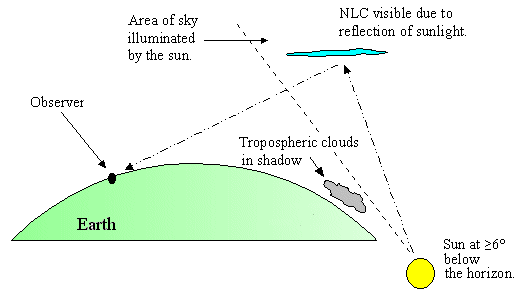
High-latitude sky watchers should be alert for their return. Observing tips: Look west 30 minutes or so after sunset when the sun has dipped below the horizon. If you see luminous blue-white tendrils spreading across the sky, you may have spotted a noctilucent cloud.
Realtime Noctilucent Cloud Photo Gallery
THE BLACK HOLE PENDANT: Albert Einstein never wore jewelry, but even he might make an exception for this: The Black Hole Pendant. This singular piece of relativistic neckwear flew to the edge of space last week on board an Earth to Sky Calculus cosmic ray balloon. At the apex of its flight it was 117,454 feet above the Sierra Nevada mountains of central California:

You can have it for $119.95. The students are selling these pendants to support their cosmic ray ballooning program--an increasing necessity because of the worldwide helium shortage. Balloon flights are becoming expensive! Each pendant comes with a greeting card showing the item in flight and telling the story of its journey to the edge of space and back.
Far Out Gifts: Earth to Sky Store
All sales support hands-on STEM education
Free: Spaceweather.com Newsletter