SOLAR MINIMUM CONDITIONS ARE IN EFFECT: The sun has been without sunspots for 78 days so far this year--more than half the time. To find a similar number of blank suns, you have to go back to 2009 when the sun was experiencing the deepest solar minimum in a century. Solar minimum has returned, bringing extra cosmic rays, long-lasting holes in the sun's atmosphere, and strangely pink auroras. Aurora Alerts: SMS Text.
NOCTILUCENT CLOUD SEASON BEGINS: NASA's AIM spacecraft has spotted wispy patches of electric-blue drifting over the Arctic Ocean. This marks the beginning of the 2019 season for noctilucent clouds (NLCs). The clouds are boxed in this polar image recorded by AIM's CIPS instrument (zoom in):

These first detections from space are small and faint. They won't remain faint for long, however. Previous data from AIM have shown that NLCs are like a great "geophysical light bulb." They turn on every year in late spring, reaching almost full intensity over a period of 10 days. This means observers on the ground should soon begin to see them.
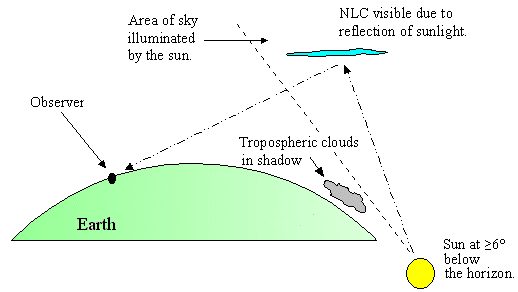
NLCs are Earth's highest clouds. Seeded by meteoroids, they float at the edge of space more than 80 km above the planet's surface. The clouds are very cold and filled with tiny ice crystals. When sunbeams hit those crystals, they glow electric-blue.
This is what a fully-realized noctilucent cloud looks like, photographed over the Lille Vildmose Wild Life Park in Denmark by Pernille Fjeldgaard Jensen on July 6, 2018:

Early-season NLCs are always found at high-latitudes--e.g., Canada, the British isles, Siberia and Scandinavia. To people in those areas, we offer the following observing tips: Look west 30 to 60 minutes after sunset when the sun has dipped below the horizon. If you see luminous blue-white tendrils spreading across the sky, you may have spotted a noctilucent cloud.
Realtime Noctilucent Cloud Photo Gallery
FAR-OUT FATHER'S DAY GIFT: Father's Day is only 3 weeks away. Is your dad a Trekkie? Here's a gift to make him live long and prosper. The students of Earth to Sky Calculus launched the Enterprise to the stratosphere. Riding onboard a high-altitude cosmic ray balloon, the laser-etched crystal spaceship traveled 34.7 km (113,845 feet) above Earth's surface:
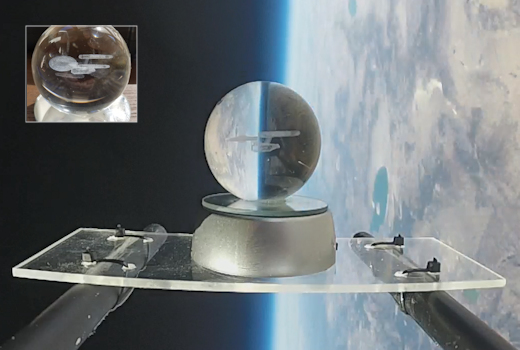
You can have it for $149.95. The students are selling the Enterprise to support their cosmic ray ballooning program. Each starship comes with a greeting card showing the item in flight and telling the story of its journey to the edge of space. Also included is a multi-colored LED stand. This creates a colorful visual effect and allows the Enterprise to be used as a far-out night light.
Dad-satisfaction guaranteed!
Far Out Gifts: Earth to Sky Store
All sales support hands-on STEM education
Free: Spaceweather.com Newsletter