NOCTILUCENT CLOUD SEASON BEGINS: NASA's AIM spacecraft has spotted wispy patches of electric-blue drifting over the Arctic Ocean. This marks the beginning of the 2019 season for noctilucent clouds (NLCs). Soon, observers in northern countries will begin to see these night-shining clouds with the unaided eye. Get the full story and observing tips here.
A CLOSE ENCOUNTER WITH THE TAURID SWARM: In November 2032, Earth will pass through the Taurid Swarm, a cloud of debris from Comet 2P/Encke that makes brilliant fireballs when its gravelly particles occasionally hit Earth's atmosphere. Previous encounters with the Swarm in 2005 and 2015 produced showers of bright meteors observed around the world; in 1975 the Swarm contacted the Moon, making Apollo seismic sensors ring with evidence of objects hitting the lunar surface. If forecasters are correct, we're in for similar activity 22 years from now.
Some researchers are beginning to wonder if there might be more to the Taurid Swarm than the pebble-sized particles that make fireballs–something, say, that could level a forest. On June 30, 1908, a forest in Siberia did fall down when a 100-meter object fell out of the sky and exploded just above the Tunguska River. Back-tracking the trajectory of the impactor suggests it may have come from the Taurid Swarm.

Trees felled by the Tunguska explosion. Credit: the Leonid Kulik Expedition
Why would the Swarm contain such big rocks? After all, comet debris is normally no bigger than specks of dust. The most popular theory holds that 10 or 20 thousand years ago, a giant 100-km wide comet fragmented in the inner solar system. The breakup produced a mixture of dust and asteroid-sized bodies that are still present today. Comet 2P/Encke itself may be just one of the fragments.
If the Taurid Swarm does indeed contain Tunguska-class impactors, the people of Earth need to know. A team of astronomers from the University of Western Ontario (UWO) suggests that this summer is a great time to find out.
"In June 2019 the Earth will approach within [0.06 AU or 9 million km] of the center of the Taurid swarm, its closest post-perihelion encounter with Earth since 1975," write UWO astronomers David Clark, Paul Wiegert and Peter Brown in a paper just accepted for publication in the Monthly Notices of the Royal Astronomical Society. "This will be the best viewing geometry to detect and place limits on the number of Near-Earth Objects proposed to reside at the swarm center until the early 2030s."
To be clear, the team won't be looking for fireballs disintegrating in Earth's atmosphere. Instead, they want to point powerful telescopes at the Swarm, peering deep inside it to see if they can find big, dangerous pieces of rock gliding among the pebbles.
"Seeing anything in the Taurid Swarm will be tough," says Wiegert. "It's faint, it's spread across a lot of sky, and it's moving fast. A fair dash of serendipity will be needed to catch a glimpse of it. But we have to try to strike when the iron is hot, and that's now."
"We've applied for 10 hours of time on the Canada-France-Hawaii Telescope atop Mauna Kea," he adds. "And we're hoping other big telescopes will join the search as well."
To learn more about this year's close encounter with the Taurid Swarm, read the original research at https://arxiv.org/pdf/1905.01260.pdf
Free: Spaceweather.com Newsletter
FAR-OUT FATHER'S DAY GIFT: Father's Day is only 3 weeks away. Is your dad a Trekkie? Here's a gift to make him live long and prosper. The students of Earth to Sky Calculus launched the Enterprise to the stratosphere. Riding onboard a high-altitude cosmic ray balloon, the laser-etched crystal spaceship traveled 34.7 km (113,845 feet) above Earth's surface:
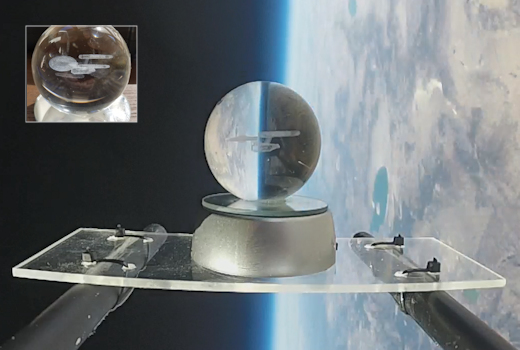
You can have it for $149.95. The students are selling the Enterprise to support their cosmic ray ballooning program. Each starship comes with a greeting card showing the item in flight and telling the story of its journey to the edge of space. Also included is a multi-colored LED stand. This creates a colorful visual effect and allows the Enterprise to be used as a far-out night light.
Dad-satisfaction guaranteed!
Far Out Gifts: Earth to Sky Store
All sales support hands-on STEM education
Realtime Noctilucent Cloud Photo Gallery